


I hear this one all the time. "I'm short. A very bearish candle prints. Price is likely to keep going that way, so I should leave my trade open longer." This is the Giant Bearish Engulfing Candle of the Loch Ness Monster I promised you in #40. It sounds like reading the tape. It's a candle rule being used as an exit, so I can test it the same way I tested the entries.
First it needs a definition, because "very bearish" means something different to everybody. I called a candle very bearish when its range was at least twice the ATR and it closed in the bottom quarter of that range. Very bullish is the mirror image. On 5-minute, 15-minute and 60-minute bars of NQ, ES, gold and crude since 2008 there were about 101,000 of them. I pooled the bullish and bearish ones and measured everything in the candle's own direction. Then I asked the same thing the trader holding the position is asking. A few bars from now, has price gone further my way?
Three bars later it had gone further my way 49.0 percent of the time. Five bars later, 49.2. Ten bars later, 49.8. Across the four markets and three bar sizes, the ten-bar number ran from 48 to 51.
So half the time it keeps going and half the time it comes back at you.
We call that a coin flip, friends. And do we trade coin flips, or do we trade edges?
The average follow-through isn't exactly zero, and I'm not going to pretend it is. Beside matched random bars, price moved an extra 0.04 ATR in the candle's direction over the next ten bars. The candle itself was at least 2 ATR. What's left is about a fiftieth of what you just watched. It ran from nothing in some markets to a tenth of an ATR in the best one, and it didn't pass the checks from #40. You can't even see a number that small on a chart. You sure can't build an exit on it. But I include that for sake of completeness.
The big candle does tell you one thing. The bars that follow it are larger than usual. That held in every market on the 5-minute and 15-minute bars. Size carries over and direction doesn't.
Now think about what holding longer does with that. Your odds on direction are no better than they were, and the bars are bigger. You took on more risk for the same expectation. Some days that pays. Some days it hands back the whole candle and you sit there wondering what happened. It's literally a coin flip.
This is why we have some naive closes like time entropies. If the edge is gone statistically speaking from the entry, why hold? Let's close and look for a new one. I don't care what the candles are doing at that moment - they literally can't tell me anything that will be net positive to the algorithm in deciding its exit. If anything, they suggest higher risk with larger candle sizes and coin flip results. And I tested and proved it.
So why does everybody believe it? Same reason as #29. You remember the big red candle that started the flush, because you were short and it was a great day. The big red candle that got bought back in two bars gets filed under bad luck. This is human nature. We want to remember our successes and purge our failures from our memory.
And there's a second reason. By the time the candle has closed, the move you wanted is already inside it. The candle is a picture of a move you've captured already. It says nothing about profit you don't have yet.
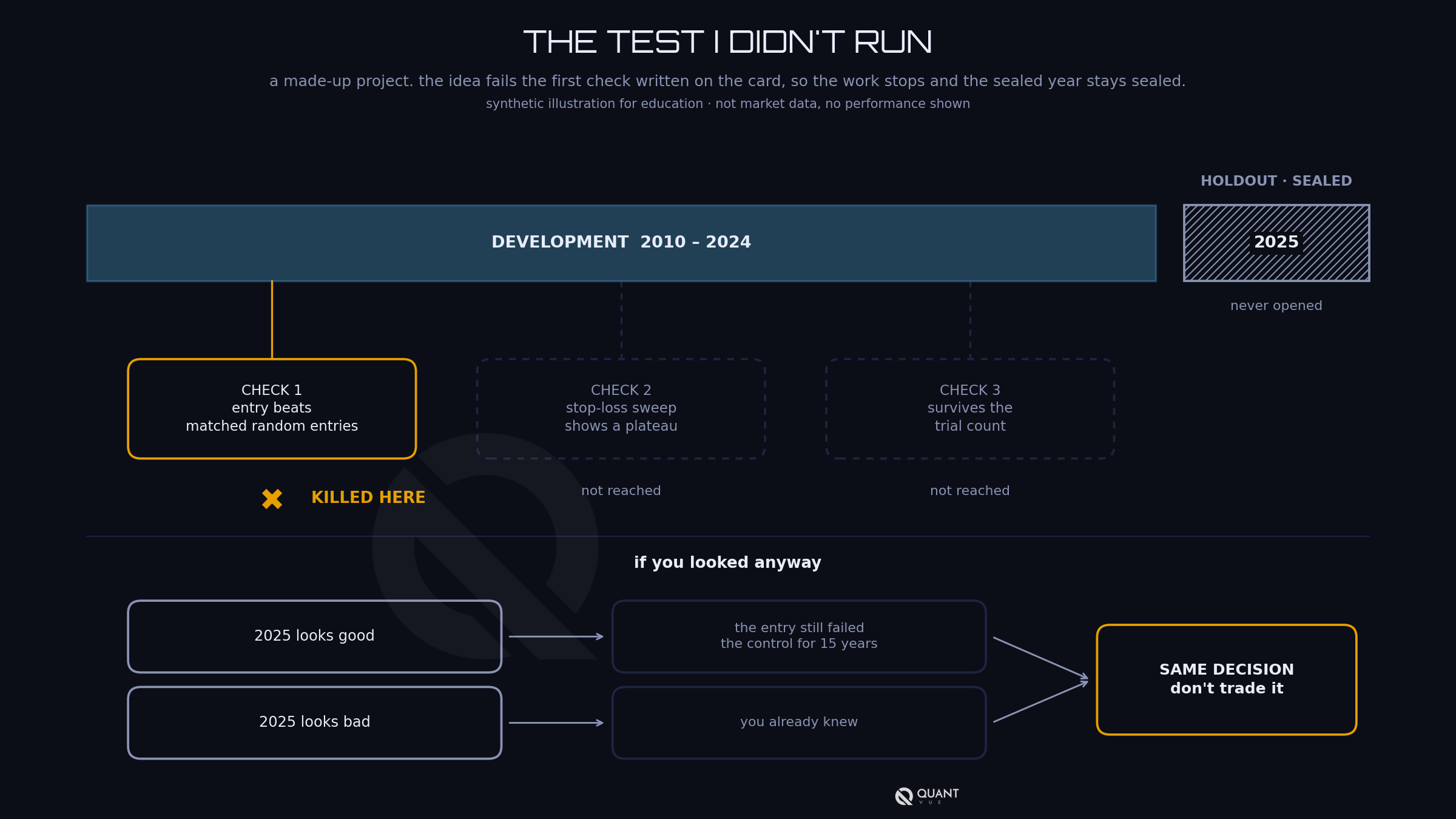
So where does the exit come from? From the plan you wrote before the trade. #24 and #25 covered how to set the stop and the target from a sweep. If you believe a momentum rule should extend your exits, great, write it down as a rule. Something like "after a candle of this size, trail the stop by this much". Then run it on the full trade list against a control and count it as a trial. I'll tell you from personal experience that it doesn't work well in algos.
Changing the exit in the middle of a trade because of one candle is the manual override from #31, a strategy with a sample size of one.
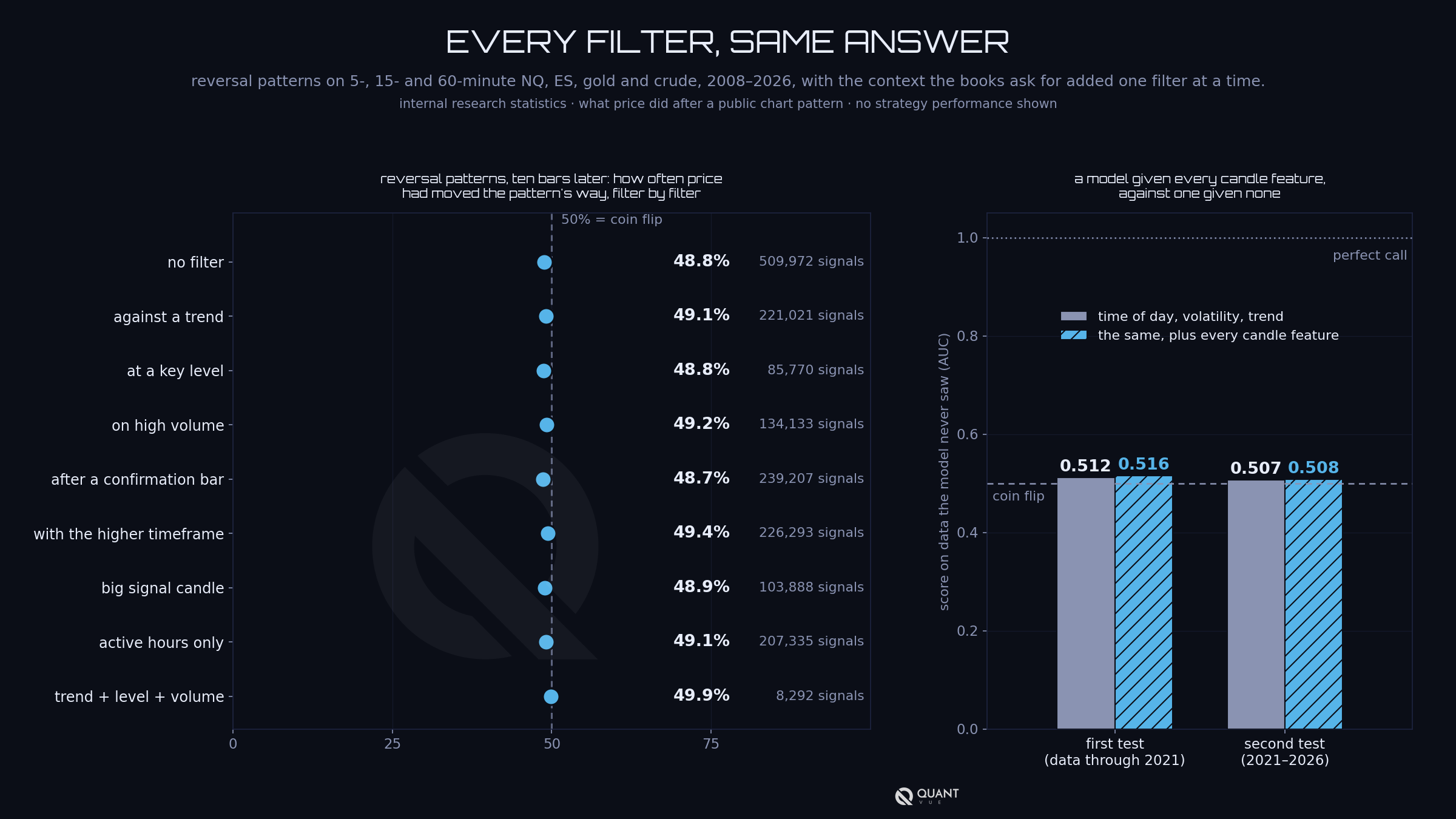
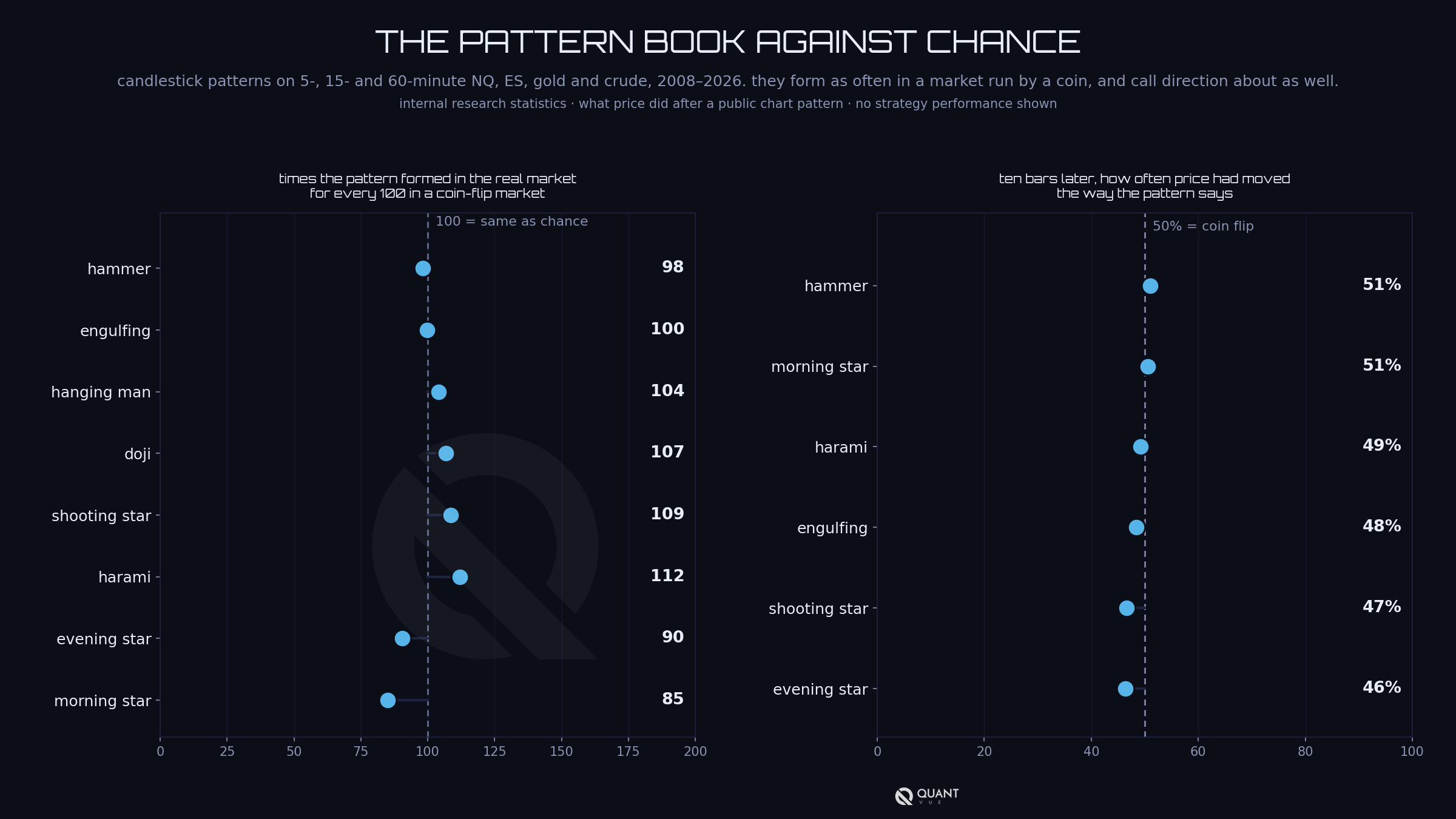
That's three lessons on candles. They're a good way to draw price, and I look at them all day. As entry and exit signals for code, 61 patterns and 26 rules over 18 years gave me nothing I would trade.
Trade well and let the plan close the trade.
This lesson was originally sent to the Algo Creator School email list on November 20, 2026. New lessons go out by email regularly. Join the list at quantvue.io.
Educational content only, not financial advice. Futures trading involves substantial risk of loss and is not suitable for all investors. Individual results vary, and past performance, actual or simulated, does not guarantee future results.


After check out, you will receive a Welcome Email with your login details.
Use these details to Login to our dashboard, where you'll then submit your TradingView or NinjaTrader information.
Access is granted automatically if the form is filled out properly.
If you are having issues with access being granted, please submit a support ticket here.
No. Our core system is designed for those with baseline trading knowledge and live-trading experience. Do not sign up if you're a beginner trader. Intermediate to advanced experience is recommended.
No. There is no algorithm or indicator that can accurately predict with 100% certainty the financial markets.
QuantVue is not responsible for trading losses. Past results are never indicative of future performance. Use QuantVue and trade at your own risk.
Our tools are designed for futures. However, clients can tweak our toolkit to any chart or market.
Most clients use a paid TradingView plan, and the most popular among users is TradingView premium.
You can manage your account in the "My Account" tab or submit a support ticket here and we will process your cancellation immediately!
Our monthly & yearly Pro / Elite plans are backed by a 30-day money back guarantee. If you are not 100% satisfied within 30 days from the time of purchase, you may request a full refund.
Beyond the 30-day period, all sales are final.
The 30 day money back guarantee only applies to first time customers. If you have used our system or had a plan in the past, you are not eligble for a refund. This means if you have used the PRO plan in the past and sign up for ELITE at a later date, you will not be elgible for the refund guarantee and vice versa.
This refund policy does not apply to our ATS program.
See our full refund policy here.
There is a separate money back guarantee for the ATS Program. The ATS refund policy has certain conditions that must be met to receive a full refund.
See our full ATS refund policy here.
The Elite Plan on it's own does not automate into cash or prop firm accounts.
If you want to automate our tools into cash or prop accounts, you can do so via our alert connector QuantLynk here.
Keep in mind QuantLynk is detectable by prop firms, so we recommend using an automation-friendly prop firm.
To automate our tools into prop account undetected, we recommend our ATS Program here.
No. There is no free trial on the ATS program.