

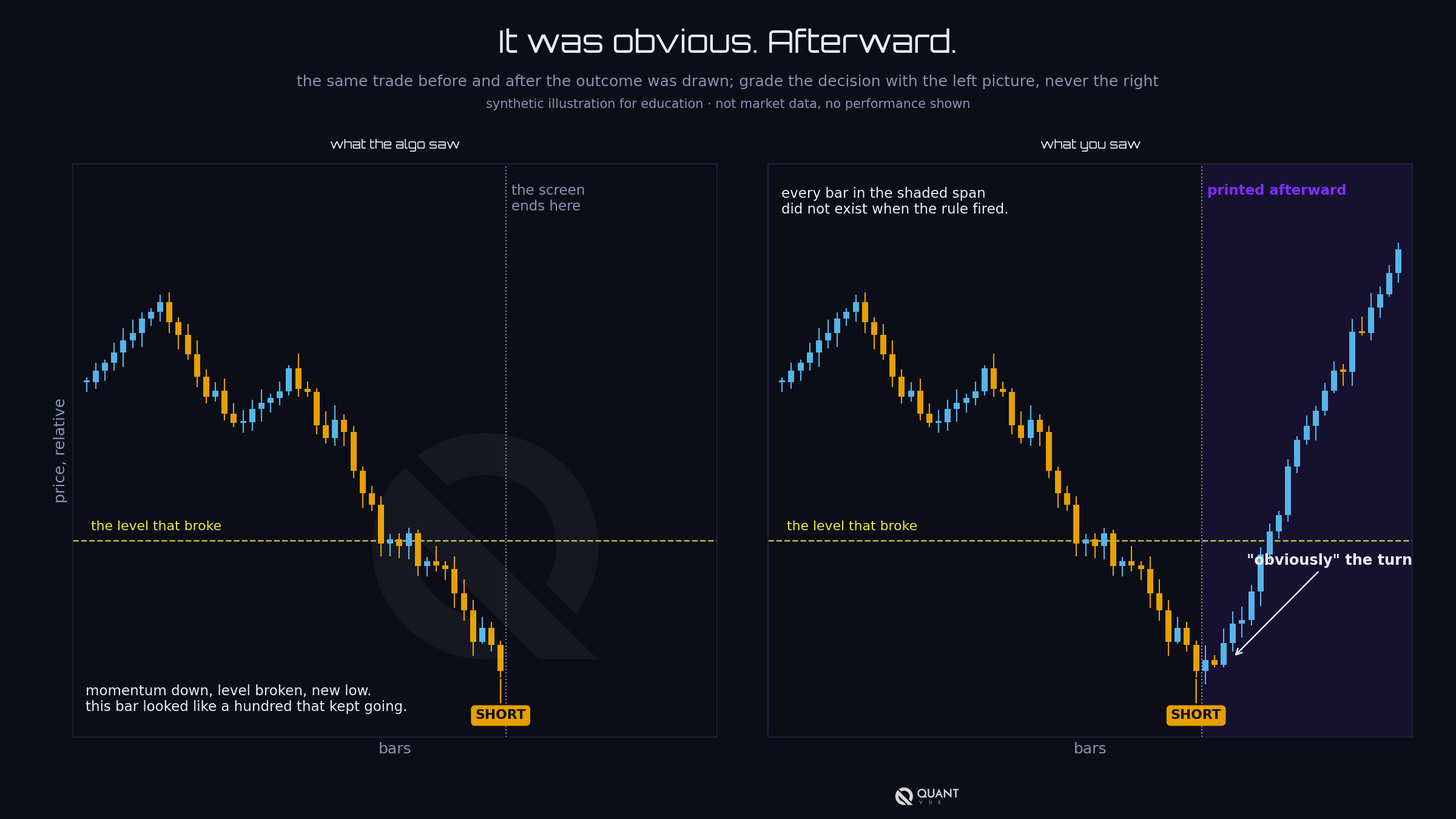
The message I get most often after a red day is some version of "it was clear it shouldn't have shorted there." Sometimes with three exclamation marks. And when I open the chart, they're right. It's obvious. The short went in near the low of the day and the market ran the other way for the rest of the session. Anyone could see it. The problem is the word "see."
The chart you're looking at has a right side. The algo's chart didn't. At the bar the short went in, the screen ended at that bar. Everything to the right of it, the turn, the run, the exact candle where it "obviously" reversed, hadn't printed yet. The reversal that makes the short look stupid is the one thing the algo could not have known about, because it hadn't happened. You're grading a decision with information the decision maker didn't have. Every time.
This has a name, hindsight bias, and it's been measured since the 1970s. Tell people how something turned out and they rate it as far more foreseeable than people who weren't told, and they can't undo it even after you explain the effect to them. A price chart is the worst possible version of it, because the outcome is drawn on the same picture as the decision, and your eye reads the whole picture at once. The reversal was "clear" because it's on the screen now. It was not on the screen at 10:47. Had the situation been opposite, the plummet continued, then the viewer would likely say "well the selloff was clear, great job for the algo!"
Try this with the trade you're upset about. Crop the screenshot at the entry bar so everything to the right is gone. Now look at what's left and ask honestly whether you'd have shorted. Most of the time the left side looks like a short. That's why the rule fired. Momentum was down, the level had broken, whatever mechanism the strategy was written around. That bar looked like a hundred other bars that did keep going. This one didn't. That's a loss and is expected. A mistake is something else, which we'll discuss soon.
A decision and an outcome are two different things, and this whole series has been about grading the decision. The rule was written down before it was tested. It ran over a few hundred trades with fills you could have gotten. Its stop and target sit on a plateau, and its drawdown distribution is known and this loss sits inside it. That is a good decision. A good decision has a bad outcome about as often as the win rate says it will, and the win rate on most of what we run is nowhere near a hundred percent. If a strategy wins 55% of the time, then 45 of every hundred trades will look, afterward, like it should have known better. That's arithmetic, and it's the arithmetic you signed up for when you turned it on.
The reverse also holds, and nobody complains about that direction. Every winning trade had a right side the algo couldn't see either. Some of those wins were bad decisions that got paid, a rule firing in a regime it wasn't built for and getting bailed out by a news print. Nobody has ever sent me a message saying "it was clear that long shouldn't have worked." Outcome bias only stings one way, which tells you it's about the feeling and not about the strategy.
One trade carries almost no information about a rule. If the win rate is 55% over 400 trades, one more loss moves that estimate by a rounding error. The trade list is the evidence. The trade you're staring at is one row in it. Rewriting a rule because of one row is the overfitting from week two, done with a chart and a grudge instead of a parameter sweep.
When we trade we have to remove emotions. Whether it's manual, automated, your algos or mine. Emotions must always be removed from the situation and statistics are all that matters.
Friday is the second half of that message, the "it should have waited for X" half. That one is more dangerous, because it sounds like analysis.
This lesson was originally sent to the Algo Creator School email list on September 30, 2026. New lessons go out by email regularly. Join the list at quantvue.io.
Educational content only, not financial advice. Futures trading involves substantial risk of loss and is not suitable for all investors. Individual results vary, and past performance, actual or simulated, does not guarantee future results.


After check out, you will receive a Welcome Email with your login details.
Use these details to Login to our dashboard, where you'll then submit your TradingView or NinjaTrader information.
Access is granted automatically if the form is filled out properly.
If you are having issues with access being granted, please submit a support ticket here.
No. Our core system is designed for those with baseline trading knowledge and live-trading experience. Do not sign up if you're a beginner trader. Intermediate to advanced experience is recommended.
No. There is no algorithm or indicator that can accurately predict with 100% certainty the financial markets.
QuantVue is not responsible for trading losses. Past results are never indicative of future performance. Use QuantVue and trade at your own risk.
Our tools are designed for futures. However, clients can tweak our toolkit to any chart or market.
Most clients use a paid TradingView plan, and the most popular among users is TradingView premium.
You can manage your account in the "My Account" tab or submit a support ticket here and we will process your cancellation immediately!
Our monthly & yearly Pro / Elite plans are backed by a 30-day money back guarantee. If you are not 100% satisfied within 30 days from the time of purchase, you may request a full refund.
Beyond the 30-day period, all sales are final.
The 30 day money back guarantee only applies to first time customers. If you have used our system or had a plan in the past, you are not eligble for a refund. This means if you have used the PRO plan in the past and sign up for ELITE at a later date, you will not be elgible for the refund guarantee and vice versa.
This refund policy does not apply to our ATS program.
See our full refund policy here.
There is a separate money back guarantee for the ATS Program. The ATS refund policy has certain conditions that must be met to receive a full refund.
See our full ATS refund policy here.
The Elite Plan on it's own does not automate into cash or prop firm accounts.
If you want to automate our tools into cash or prop accounts, you can do so via our alert connector QuantLynk here.
Keep in mind QuantLynk is detectable by prop firms, so we recommend using an automation-friendly prop firm.
To automate our tools into prop account undetected, we recommend our ATS Program here.
No. There is no free trial on the ATS program.