

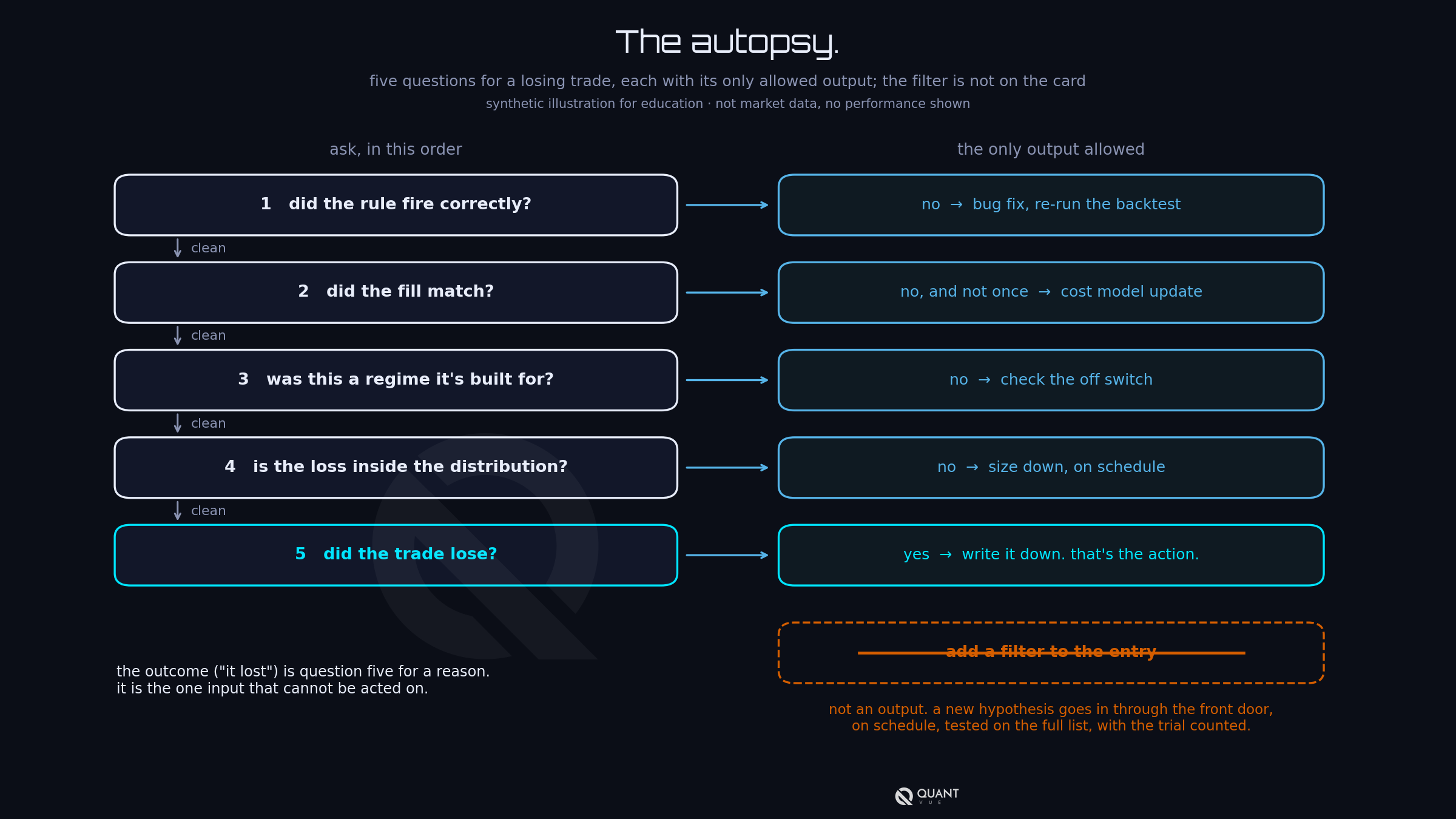
Two emails on why hindsight lies. This one is what to do instead, because "don't look at losing trades" is bad advice. Look at every one. Ask it the right questions, in an order, with the outcome sitting at the end where it can't lead the review.
One. Did the rule fire correctly? Pull the bar. Check the conditions the strategy is written to check, against the data as it stood at that bar. The chart now doesn't count. Crop the right side off, like last Wednesday. If the rule fired when it shouldn't have, that's a bug, and a bug is the one case where a single trade is enough evidence. Fix it, re-run the backtest, and confirm the trade list changes the way you expect and nothing else moves. If the rule fired correctly, keep going.
Two. Did the fill match? Compare the fill to the price the rule asked for. The backtest's fill was a guess and the live fill is the truth. One bad fill is noise. Twenty in a row is a cost you haven't modelled, and it belongs in the cost model and the doubled-cost test, never in the entry rule.
Three. Was this a regime the strategy is built for? Every strategy has regimes it favors (that's why ours are regime-routed) and the off switch is a written rule. If the trade happened in a regime where the switch should have been off, the failure is in the switch or its trigger, and that's what gets checked. Adding a filter to the entry to patch a broken switch is how you end up with two broken rules.
Four. Is the loss inside the distribution? Take the drawdown this loss contributed to and check it against the Monte Carlo you already ran. A drawdown at the 60th percentile of what your own simulation said to expect is the strategy doing what it said on the label. A drawdown past the 95th percentile is a real signal, and it's still not a signal to add a filter. It's a signal to size down on schedule and re-run the distribution with the new trades in it.
Five. Did the trade lose? Yes. Write it down. That's the whole action. If the four questions before it came back clean, the trade is a paid-for sample, and the sample is what makes the strategy worth trading. You bought one row in the trade list. It cost you one loss. This is our forward data, and it's the most important result we get.
Notice where "add a filter" appears in those five questions. It doesn't. A filter is a new hypothesis and it comes in through the front door, on schedule, tested on the full list, with the trial counted. The autopsy has five possible outputs. A bug fix. A cost model update. A switch check. A size change. A log entry. If your review ends with a sixth, the review ran on the outcome, and the outcome is the one input you can't act on.
The trap underneath all of this is the manual override. You watch the algo enter, the last loss is still fresh, and you close it early or skip the next one. An override is a strategy with a sample size of one, untested by definition. It also breaks the trade list, so the Monte Carlo you ran no longer describes what you're trading. If you can't leave a rule alone, the rule isn't finished, and the place to finish it is the research pass, on a weekend, with the sweep. Never at 10:47 with your hand on the mouse.
The market will keep handing you trades that look obvious afterward. Every one of them looked like every other trade at the time. That's the job of the rules. Exploit an edge and become profitable over time. Odds are that some of those trades will take place on a full moon with Venus in retrograde, but that's not a reason to add a rule without careful hypothesis exploration.
This lesson was originally sent to the Algo Creator School email list on October 5, 2026. New lessons go out by email regularly. Join the list at quantvue.io.
Educational content only, not financial advice. Futures trading involves substantial risk of loss and is not suitable for all investors. Individual results vary, and past performance, actual or simulated, does not guarantee future results.


After check out, you will receive a Welcome Email with your login details.
Use these details to Login to our dashboard, where you'll then submit your TradingView or NinjaTrader information.
Access is granted automatically if the form is filled out properly.
If you are having issues with access being granted, please submit a support ticket here.
No. Our core system is designed for those with baseline trading knowledge and live-trading experience. Do not sign up if you're a beginner trader. Intermediate to advanced experience is recommended.
No. There is no algorithm or indicator that can accurately predict with 100% certainty the financial markets.
QuantVue is not responsible for trading losses. Past results are never indicative of future performance. Use QuantVue and trade at your own risk.
Our tools are designed for futures. However, clients can tweak our toolkit to any chart or market.
Most clients use a paid TradingView plan, and the most popular among users is TradingView premium.
You can manage your account in the "My Account" tab or submit a support ticket here and we will process your cancellation immediately!
Our monthly & yearly Pro / Elite plans are backed by a 30-day money back guarantee. If you are not 100% satisfied within 30 days from the time of purchase, you may request a full refund.
Beyond the 30-day period, all sales are final.
The 30 day money back guarantee only applies to first time customers. If you have used our system or had a plan in the past, you are not eligble for a refund. This means if you have used the PRO plan in the past and sign up for ELITE at a later date, you will not be elgible for the refund guarantee and vice versa.
This refund policy does not apply to our ATS program.
See our full refund policy here.
There is a separate money back guarantee for the ATS Program. The ATS refund policy has certain conditions that must be met to receive a full refund.
See our full ATS refund policy here.
The Elite Plan on it's own does not automate into cash or prop firm accounts.
If you want to automate our tools into cash or prop accounts, you can do so via our alert connector QuantLynk here.
Keep in mind QuantLynk is detectable by prop firms, so we recommend using an automation-friendly prop firm.
To automate our tools into prop account undetected, we recommend our ATS Program here.
No. There is no free trial on the ATS program.