

Monday was the stop. Today the target, which sweeps the same way and fools people in the opposite direction.
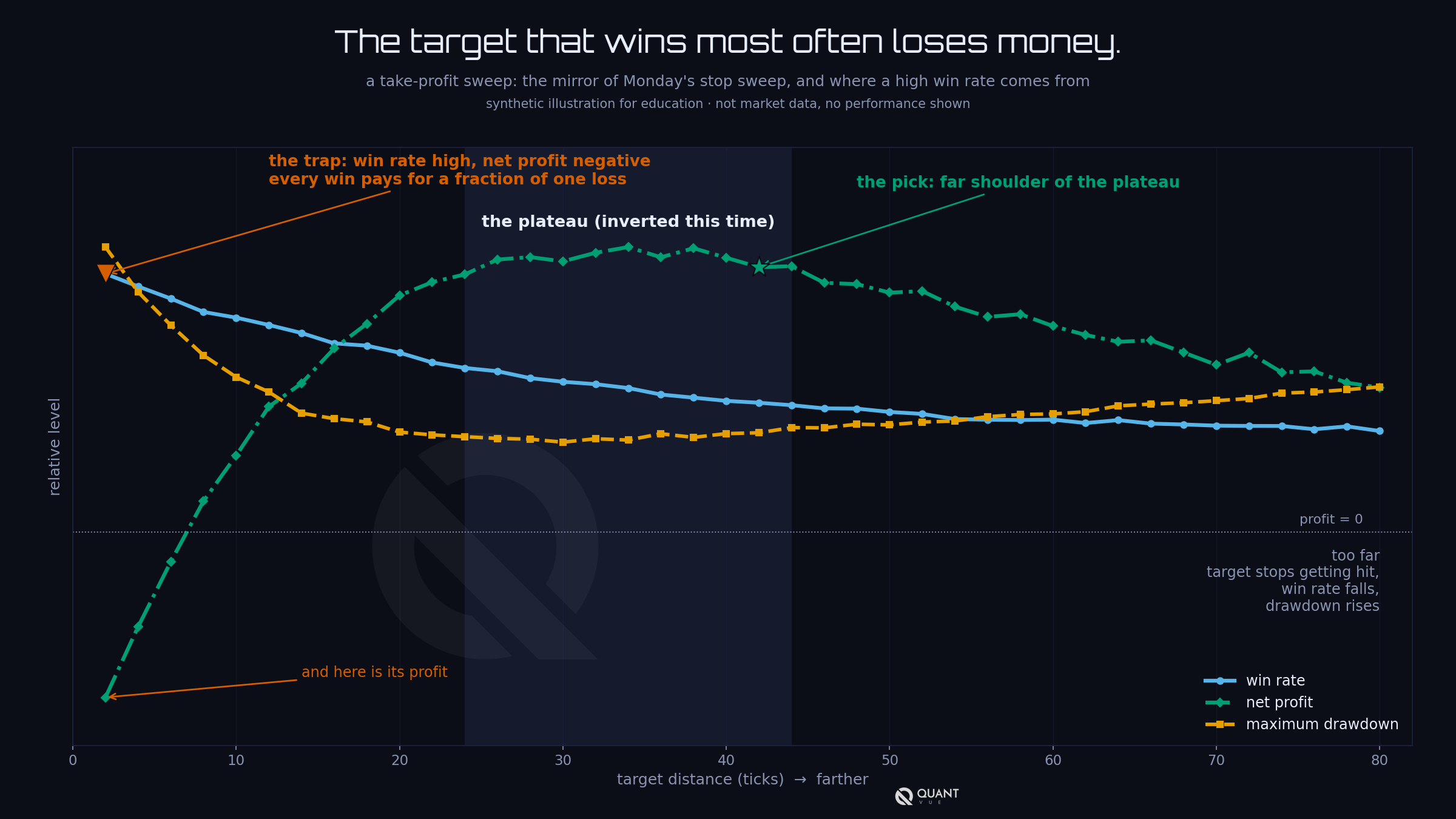
Sweep the take-profit from close to far and plot win rate, net profit, and maximum drawdown against it. The shape is the mirror of the stop sweep.
On the far side, win rate falls. The target is out past where the move usually ends, so trades that were winners at a nearer target turn around and hit the stop instead. Losses climb, drawdown climbs. On the near side, win rate rises and keeps rising, which is the trap. Profit falls at the same time, and drawdown starts climbing again, because each win is now too small to pay for the losses that did not shrink. You cannot tighten the losses by tightening the target. Between the two sits the plateau again, inverted this time, a shelf of targets that produce a similar look to the stop curve, and that shelf is where a setting comes from.
Read the near side again because it is where most retail systems live. A target of two ticks against a stop of twenty will win most of the time, and every one of those wins pays for a tenth of one loss. The win rate is real. The strategy is still a losing one, with a drawdown curve that looks calm right up until it is not. A high win rate is a property of the target distance, not evidence of an edge, and anyone selling you a strategy on its win rate is selling you the left edge of this chart.
Stops and targets interact, so the honest way to tune them is a grid, both at once. Run the grid, but read each axis on its own first. Hold the stop at its plateau and sweep the target, then hold the target and sweep the stop. If either marginal shape is not the one you expected, the grid will not save you. It will hand you a bright cell in a noisy field and that cell is the most overfit number in the whole study.
Count the cells. A ten by ten grid is a hundred trials, and week two covered what a hundred trials does to your best result. Deflate accordingly before you believe the cell you picked. Remember the deflated Sharpe number? If you used a huge grid then you gotta account for that.
Same closing rule as Monday. No clean shape, no pick. Find out why first.
These rules will give you a good starting place. They'll give you a good number to start your testing with, and a bit of confidence that the edge might be real and not just a randomly bright cell in a heatmap (which is overfitting).
Friday, the number that decides, and why the order you read your metrics in changes which cell you choose.
This lesson was originally sent to the Algo Creator School email list on September 16, 2026. New lessons go out by email regularly. Join the list at quantvue.io.
Educational content only, not financial advice. Futures trading involves substantial risk of loss and is not suitable for all investors. Individual results vary, and past performance, actual or simulated, does not guarantee future results.


After check out, you will receive a Welcome Email with your login details.
Use these details to Login to our dashboard, where you'll then submit your TradingView or NinjaTrader information.
Access is granted automatically if the form is filled out properly.
If you are having issues with access being granted, please submit a support ticket here.
No. Our core system is designed for those with baseline trading knowledge and live-trading experience. Do not sign up if you're a beginner trader. Intermediate to advanced experience is recommended.
No. There is no algorithm or indicator that can accurately predict with 100% certainty the financial markets.
QuantVue is not responsible for trading losses. Past results are never indicative of future performance. Use QuantVue and trade at your own risk.
Our tools are designed for futures. However, clients can tweak our toolkit to any chart or market.
Most clients use a paid TradingView plan, and the most popular among users is TradingView premium.
You can manage your account in the "My Account" tab or submit a support ticket here and we will process your cancellation immediately!
Our monthly & yearly Pro / Elite plans are backed by a 30-day money back guarantee. If you are not 100% satisfied within 30 days from the time of purchase, you may request a full refund.
Beyond the 30-day period, all sales are final.
The 30 day money back guarantee only applies to first time customers. If you have used our system or had a plan in the past, you are not eligble for a refund. This means if you have used the PRO plan in the past and sign up for ELITE at a later date, you will not be elgible for the refund guarantee and vice versa.
This refund policy does not apply to our ATS program.
See our full refund policy here.
There is a separate money back guarantee for the ATS Program. The ATS refund policy has certain conditions that must be met to receive a full refund.
See our full ATS refund policy here.
The Elite Plan on it's own does not automate into cash or prop firm accounts.
If you want to automate our tools into cash or prop accounts, you can do so via our alert connector QuantLynk here.
Keep in mind QuantLynk is detectable by prop firms, so we recommend using an automation-friendly prop firm.
To automate our tools into prop account undetected, we recommend our ATS Program here.
No. There is no free trial on the ATS program.