

Every algo trader knows the feeling. A system that printed for three months goes quiet, and the first instinct is that something broke. Usually nothing broke. The market changed underneath it. This week we put numbers on that change. Today, what a regime is and proof that regimes are real, measured things. Wednesday, the same three strategies you know from the prop arc, split by regime, and the results are not subtle. Friday, the question everyone asks next, should you switch your algo off in the weak regime, answered with simulations instead of a feeling.
A regime is a persistent state of market behavior, mostly how volatility arrives and how price ranges resolve. QuantVue runs a regime engine that reads eight structural inputs each morning, volatility pairs, range behavior, cross-asset stress among them, and emits one of four labels before the open: Strong Expansion, Passive Expansion, Passive Compression, Strong Compression. Expansion means energy, compression means quiet. One detail that matters for everything this week: when we score history we use the label each day would actually have received that morning, from a model fit only on data before it. No hindsight labels anywhere.
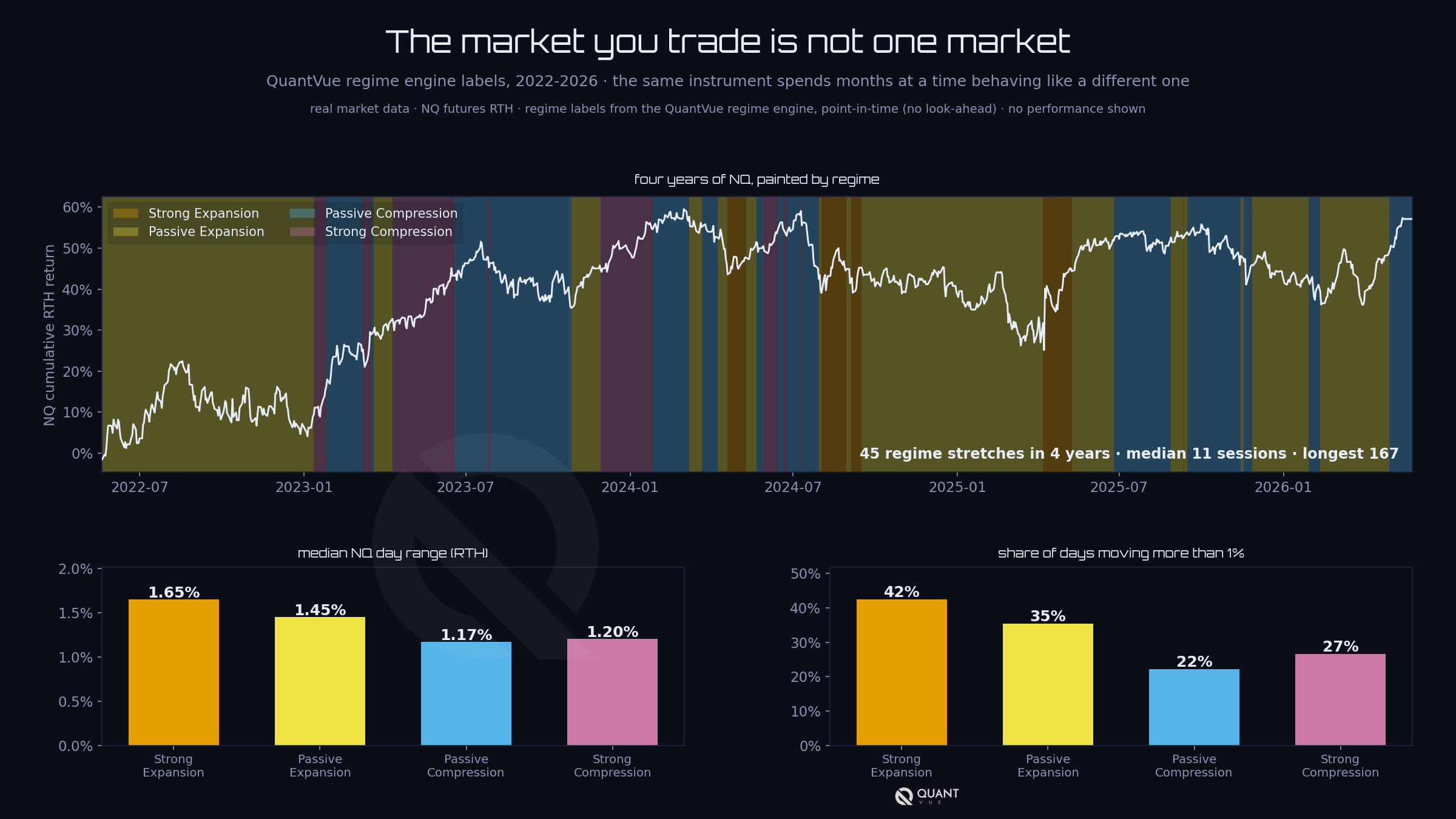
Here is four years of NQ with each session painted by its label, 2022 through this spring, 1,034 sessions. The differences are the point. Strong Expansion days ran a median 1.65% regular-session range with 42% of days moving more than 1%. Passive Compression days ran 1.17% and 22%. Median VIX was 20 in Strong Expansion and 14.5 in Strong Compression. Same ticker, same hours, a measurably different game.
Now look at how the colors arrive, in stretches, not confetti. Those 1,034 sessions contained just 45 regime stretches. The median stretch lasted 11 sessions, a quarter ran 28 or longer, and the longest ran 167. That persistence is what makes a regime worth knowing about. A coin that flips daily is trivia. A state that holds for two to eight weeks is context you can plan a trading month around.
Why this belongs in an algo school: a strategy is a bet on a kind of market. A breakout system is a bet that range extends. A mean-reversion system is a bet that it doesn't. Which means every backtest total you have ever admired is an average across regimes, and averages hide things. On Wednesday we stop averaging, take the three Omega sleeves from the prop arc, and ask each regime what it paid. One regime paid thirteen times another. Same algorithms. Same settings.
This lesson was originally sent to the Algo Creator School email list on August 17, 2026. New lessons go out by email regularly. Join the list at quantvue.io.
Educational content only, not financial advice. Futures trading involves substantial risk of loss and is not suitable for all investors. Individual results vary, and past performance, actual or simulated, does not guarantee future results.


After check out, you will receive a Welcome Email with your login details.
Use these details to Login to our dashboard, where you'll then submit your TradingView or NinjaTrader information.
Access is granted automatically if the form is filled out properly.
If you are having issues with access being granted, please submit a support ticket here.
No. Our core system is designed for those with baseline trading knowledge and live-trading experience. Do not sign up if you're a beginner trader. Intermediate to advanced experience is recommended.
No. There is no algorithm or indicator that can accurately predict with 100% certainty the financial markets.
QuantVue is not responsible for trading losses. Past results are never indicative of future performance. Use QuantVue and trade at your own risk.
Our tools are designed for futures. However, clients can tweak our toolkit to any chart or market.
Most clients use a paid TradingView plan, and the most popular among users is TradingView premium.
You can manage your account in the "My Account" tab or submit a support ticket here and we will process your cancellation immediately!
Our monthly & yearly Pro / Elite plans are backed by a 30-day money back guarantee. If you are not 100% satisfied within 30 days from the time of purchase, you may request a full refund.
Beyond the 30-day period, all sales are final.
The 30 day money back guarantee only applies to first time customers. If you have used our system or had a plan in the past, you are not eligble for a refund. This means if you have used the PRO plan in the past and sign up for ELITE at a later date, you will not be elgible for the refund guarantee and vice versa.
This refund policy does not apply to our ATS program.
See our full refund policy here.
There is a separate money back guarantee for the ATS Program. The ATS refund policy has certain conditions that must be met to receive a full refund.
See our full ATS refund policy here.
The Elite Plan on it's own does not automate into cash or prop firm accounts.
If you want to automate our tools into cash or prop accounts, you can do so via our alert connector QuantLynk here.
Keep in mind QuantLynk is detectable by prop firms, so we recommend using an automation-friendly prop firm.
To automate our tools into prop account undetected, we recommend our ATS Program here.
No. There is no free trial on the ATS program.