

A consistency rule caps how much of your profit may come from a single day, and the arithmetic surprises people. At a 20% threshold, one $1,000 day means no payout until total profit reaches $5,000. Your best day sets your homework. Firms frame this as protection against lucky gamblers, and for a human revenge-trading their way to one big day, it is. For algorithms it is something else, and today we measure it.
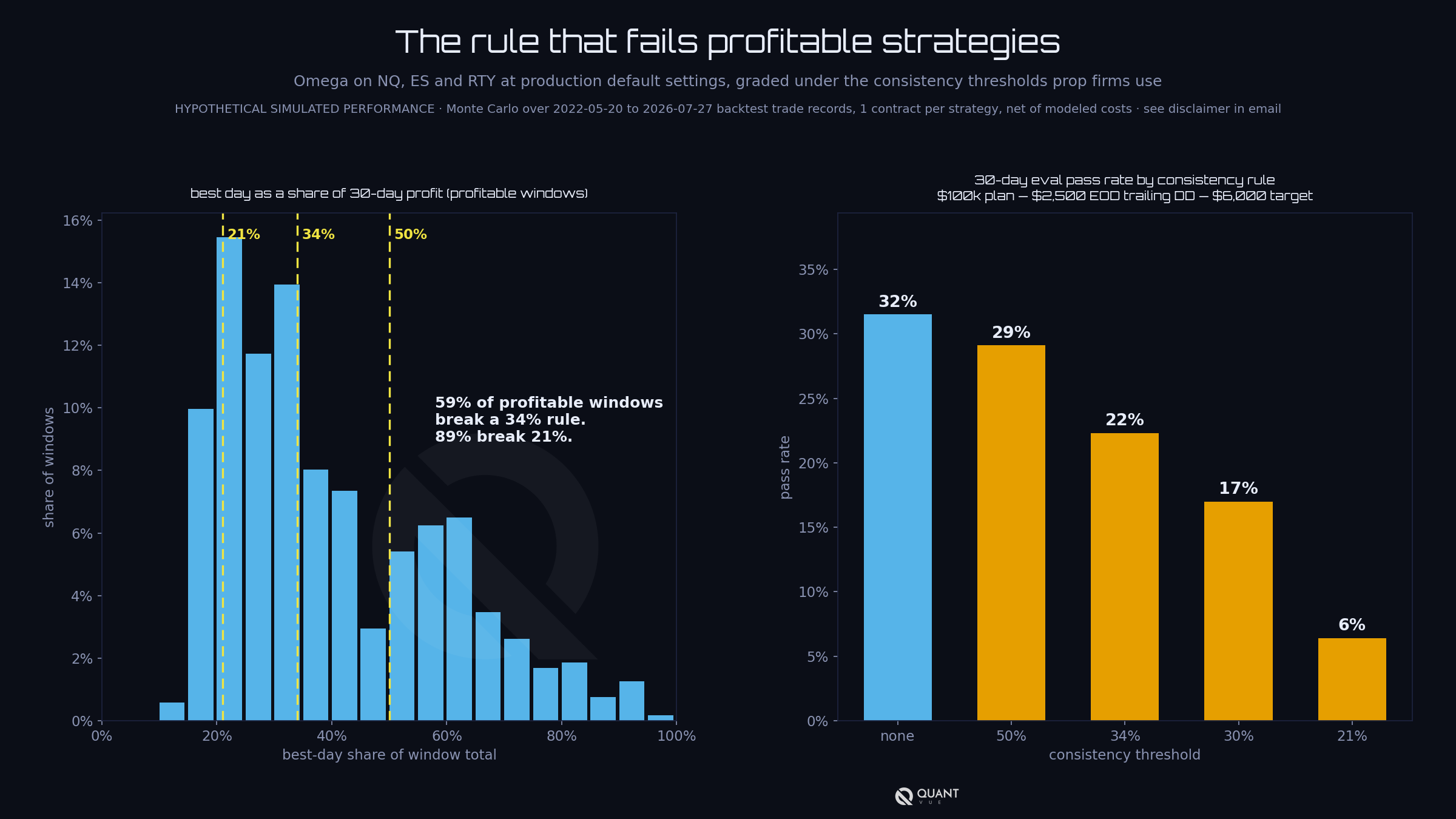
First the shape of the problem. We took the same three strategies from Friday's lesson, our Omega sleeves on NQ, ES and RTY at their production default settings, one contract each, backtested through late July, and measured every profitable 30-day window in four years. The median window took 40% of its profit from its single best day. 59% of profitable windows would breach a 34% consistency rule. 89% would breach a 21% rule. Read that again. The portfolio made money, and in nine windows out of ten a common consistency threshold would have called that profit a violation.
Edge concentration is what you are seeing, and retraining will not remove it. A selective algorithm waits for its conditions and presses when they arrive, so the month's profit lives in a handful of sessions. The steadier alternative usually means taking trades the system would rather skip.
Then we ran the evaluations, on the same account as Friday, a $100k plan with a $2,500 end-of-day trailing drawdown and a $6,000 evaluation target, attempted in 30-day windows. With no consistency rule, the portfolio passed within 30 days in 32% of simulations. Add a 34% rule and passes drop to 22%. At 21%, passes fall to 6%, one fifth of the unconstrained rate, and the median successful attempt stretches from 12 trading days to 23, which on a monthly subscription is the difference between one billing cycle and two. Nothing about the trading changed. Only the grading did.
One methodology note matters before you act on any of this. Our simulations used no daily take-profit limit. Each sleeve ran its normal per-trade targets and its best days were left alone, so every big day raised the bar the account then had to clear, best day divided by the threshold. That is the letting-it-run posture, and the numbers above are its price. The other posture is a daily profit cap, stop trading once the day reaches a fixed amount, which shrinks your best day instead of growing your required total. Nothing in the rulebooks stops you from doing it, and it costs you exactly the outlier sessions your edge was built to catch. Pick one deliberately. Capping tames the rule by giving profit away. Letting it run keeps the profit and does the extra homework.
The practical moves follow directly. Measure your strategy's best-day share before you buy any eval, because it is a five-minute calculation that predicts this entire email. Prefer plans whose evaluations carry no consistency rule. That is why we recommend BluSky's Orbit plans, and BluSky is the only firm that has given QuantVue explicit permission for our customers to run our algorithms on its accounts. Our BluSky link is trader.blusky.pro. And stack uncorrelated strategies, the three-sleeve portfolio above fails these rules less often than any sleeve alone, because someone else's good day dilutes yours. Wednesday, whether the firm can tell.
PAST PERFORMANCE IS NOT NECESSARILY INDICATIVE OF FUTURE RESULTS.
QuantVue is a software provider and is not owned by, affiliated with, or endorsed by any prop trading firm named in this email, with one disclosed exception. BluSky links in this series are referral links and QuantVue may be compensated if you open an account through them. Firm rules change often. Verify current rules with the firm before you buy an evaluation.
This lesson was originally sent to the Algo Creator School email list on August 10, 2026. New lessons go out by email regularly. Join the list at quantvue.io.
Educational content only, not financial advice. Futures trading involves substantial risk of loss and is not suitable for all investors. Individual results vary, and past performance, actual or simulated, does not guarantee future results.


After check out, you will receive a Welcome Email with your login details.
Use these details to Login to our dashboard, where you'll then submit your TradingView or NinjaTrader information.
Access is granted automatically if the form is filled out properly.
If you are having issues with access being granted, please submit a support ticket here.
No. Our core system is designed for those with baseline trading knowledge and live-trading experience. Do not sign up if you're a beginner trader. Intermediate to advanced experience is recommended.
No. There is no algorithm or indicator that can accurately predict with 100% certainty the financial markets.
QuantVue is not responsible for trading losses. Past results are never indicative of future performance. Use QuantVue and trade at your own risk.
Our tools are designed for futures. However, clients can tweak our toolkit to any chart or market.
Most clients use a paid TradingView plan, and the most popular among users is TradingView premium.
You can manage your account in the "My Account" tab or submit a support ticket here and we will process your cancellation immediately!
Our monthly & yearly Pro / Elite plans are backed by a 30-day money back guarantee. If you are not 100% satisfied within 30 days from the time of purchase, you may request a full refund.
Beyond the 30-day period, all sales are final.
The 30 day money back guarantee only applies to first time customers. If you have used our system or had a plan in the past, you are not eligble for a refund. This means if you have used the PRO plan in the past and sign up for ELITE at a later date, you will not be elgible for the refund guarantee and vice versa.
This refund policy does not apply to our ATS program.
See our full refund policy here.
There is a separate money back guarantee for the ATS Program. The ATS refund policy has certain conditions that must be met to receive a full refund.
See our full ATS refund policy here.
The Elite Plan on it's own does not automate into cash or prop firm accounts.
If you want to automate our tools into cash or prop accounts, you can do so via our alert connector QuantLynk here.
Keep in mind QuantLynk is detectable by prop firms, so we recommend using an automation-friendly prop firm.
To automate our tools into prop account undetected, we recommend our ATS Program here.
No. There is no free trial on the ATS program.