

Every lesson so far has been size-independent on purpose. Sharpe and profit factor strip the contract count out. The sweeps were run at one contract. Wednesday's histogram was per contract. That's because size is the only factor that changes the account without changing the strategy, and it should be the last one you touch. Double the size and profit doubles, drawdown doubles, and the edge is exactly what it was. Sizing can't make a bad strategy good. It can make a good strategy kill an account, however. This is, unfortunately, a downfall I've witnessed many clients deal with and it's why I preach this sort of thing.
Let me say that again for the people in the back: Improper sizing can make a good strategy kill your account.
Margin will let you trade far more contracts than you should, so affordability is the wrong starting question. Start with the drawdown you can survive, in dollars, written down before you look at the strategy. In a personal account that's the amount you can lose and keep trading the plan without flinching. In a prop account it's the trailing drawdown from weeks four and five, and remember that the trailing kind follows you up, so the room you have is the room at your high, not at your start.
Now the arithmetic. Take Wednesday's 95th percentile drawdown, per contract. Divide the drawdown you can survive by it. Round down. That's the contract count. If it rounds to zero, the answer is zero, and either the account is too small for this strategy or the strategy's tail is too wide for any account. Micros exist for the first case. Nothing fixes the second except a different strategy. And nanos are a cashgrab by the brokers, so don't bother with them.
Fixed contracts or fixed fraction. Fixed is the same count every trade until you re-run the numbers on a schedule. It's simple, it's predictable, and it's how the backtest was run, so the histogram describes it directly. Fixed fraction risks a set percentage of current equity per trade, so the count grows on the way up and shrinks on the way down. On paper it compounds and protects itself. On a small futures account it does neither, because you can't trade a fraction of a contract. It becomes fixed sizing with a step function bolted on, and the step up lands right after a hot streak, which is the worst moment to add size. Trade fixed until one contract is a small fraction of the account. Then fixed fraction starts to mean something. This is more appropriate in the context of 1 micro going to 2 going to 4 and so on.
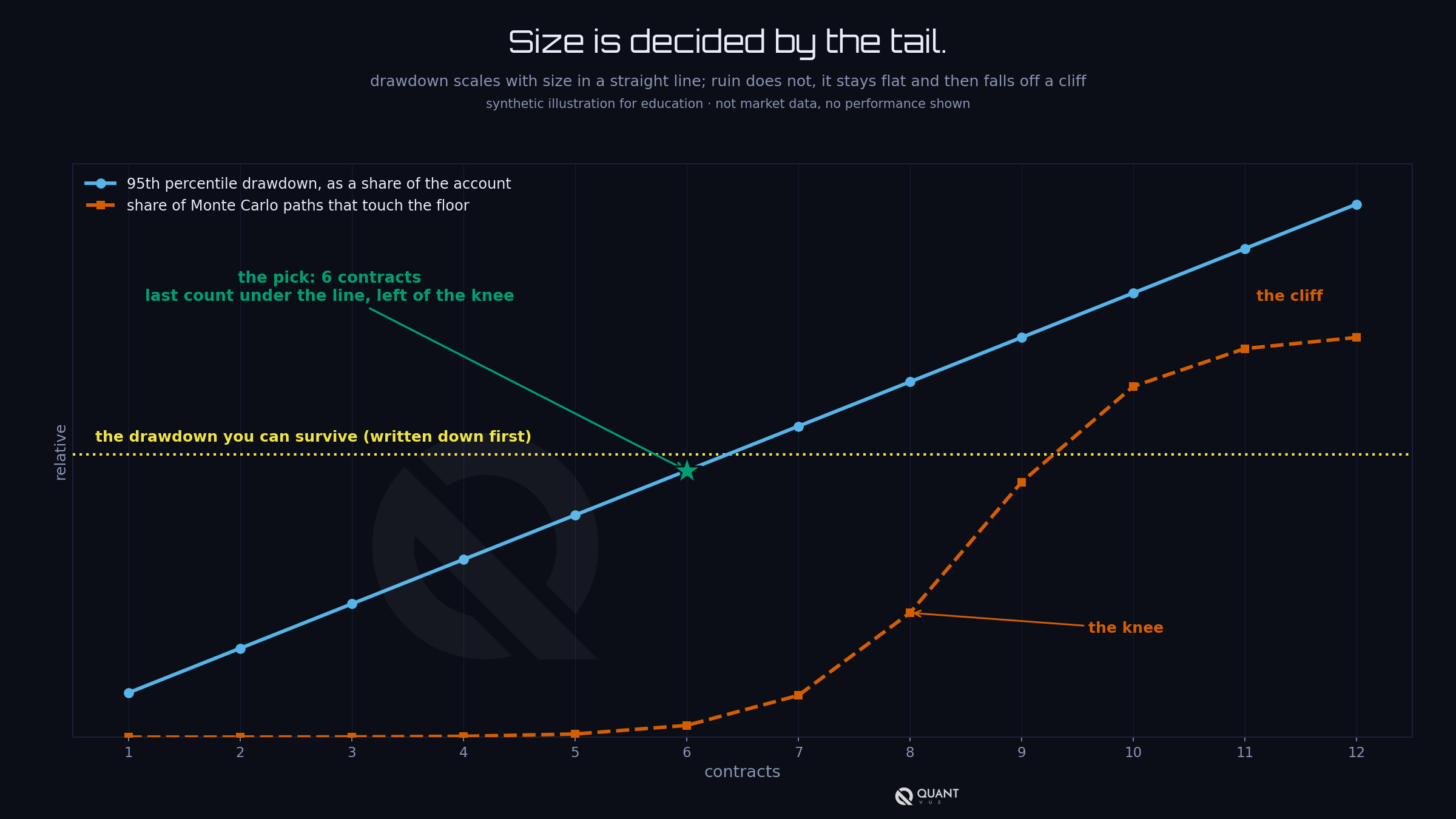
Risk of ruin is the number underneath all of this. It's the probability the account touches the floor before the edge has time to pay. Three things drive it, the edge per trade, the variance per trade, and the size relative to the account. At this stage the first two are what the strategy is. The third is yours. There's a textbook formula for it, and I'd skip it, because it assumes every win and every loss is the same size. Wednesday's Monte Carlo gives you the real thing. Replay the paths at the candidate size and count the ones that touch the floor. If that count isn't close to zero, size down and count again. The figure above is that count against contract size, and the shape is always the same. Flat for a while, then a knee, then a cliff. Stay left of the knee.
The last rule is about changing size, because that's where the discipline breaks. After a good month the urge is to add a contract. After a bad one it's to pull back to zero and wait for a feeling. Neither is a decision, they're reactions to a sample of twenty trades driven entirely by emotion. Size changes on a schedule, from the re-run distribution with the new trades included, and from nothing else. If the tail moved, size follows the tail, in either direction. Write the schedule down next to the kill number and the off-switch from week six. That's three decisions you made in advance so you don't have to make them at the worst possible time.
Always make your toughest decisions in advance, and stick to those decisions. If you're forced to make them in the moment then you're far more likely to make a bad one. Advice that is good for life, as well as trading.
This lesson was originally sent to the Algo Creator School email list on September 25, 2026. New lessons go out by email regularly. Join the list at quantvue.io.
Educational content only, not financial advice. Futures trading involves substantial risk of loss and is not suitable for all investors. Individual results vary, and past performance, actual or simulated, does not guarantee future results.


After check out, you will receive a Welcome Email with your login details.
Use these details to Login to our dashboard, where you'll then submit your TradingView or NinjaTrader information.
Access is granted automatically if the form is filled out properly.
If you are having issues with access being granted, please submit a support ticket here.
No. Our core system is designed for those with baseline trading knowledge and live-trading experience. Do not sign up if you're a beginner trader. Intermediate to advanced experience is recommended.
No. There is no algorithm or indicator that can accurately predict with 100% certainty the financial markets.
QuantVue is not responsible for trading losses. Past results are never indicative of future performance. Use QuantVue and trade at your own risk.
Our tools are designed for futures. However, clients can tweak our toolkit to any chart or market.
Most clients use a paid TradingView plan, and the most popular among users is TradingView premium.
You can manage your account in the "My Account" tab or submit a support ticket here and we will process your cancellation immediately!
Our monthly & yearly Pro / Elite plans are backed by a 30-day money back guarantee. If you are not 100% satisfied within 30 days from the time of purchase, you may request a full refund.
Beyond the 30-day period, all sales are final.
The 30 day money back guarantee only applies to first time customers. If you have used our system or had a plan in the past, you are not eligble for a refund. This means if you have used the PRO plan in the past and sign up for ELITE at a later date, you will not be elgible for the refund guarantee and vice versa.
This refund policy does not apply to our ATS program.
See our full refund policy here.
There is a separate money back guarantee for the ATS Program. The ATS refund policy has certain conditions that must be met to receive a full refund.
See our full ATS refund policy here.
The Elite Plan on it's own does not automate into cash or prop firm accounts.
If you want to automate our tools into cash or prop accounts, you can do so via our alert connector QuantLynk here.
Keep in mind QuantLynk is detectable by prop firms, so we recommend using an automation-friendly prop firm.
To automate our tools into prop account undetected, we recommend our ATS Program here.
No. There is no free trial on the ATS program.