

Wednesday ended with a temptation. The portfolio earns $792 a day in Strong Expansion and $60 in Strong Compression, so the obvious move is to stop trading the weak seasons and keep the strong ones. Today we run that switch every way it can be run, and report what actually happens.
The mechanics first, because a filter is only as good as its timing. The regime label publishes around 9:00 AM ET. The earliest entry any Omega sleeve takes is 9:30. So a same-morning filter is genuinely executable, read the label at nine, stand down if it says so, and we verified both timestamps before trusting a single result. The labels themselves are the walk-forward ones from Wednesday. Then we tested: skip each regime one at a time, keep only the two best-paying regimes, and a fully walk-forward rule that each January reviews the prior years and skips whatever regime had been a net loser so far.
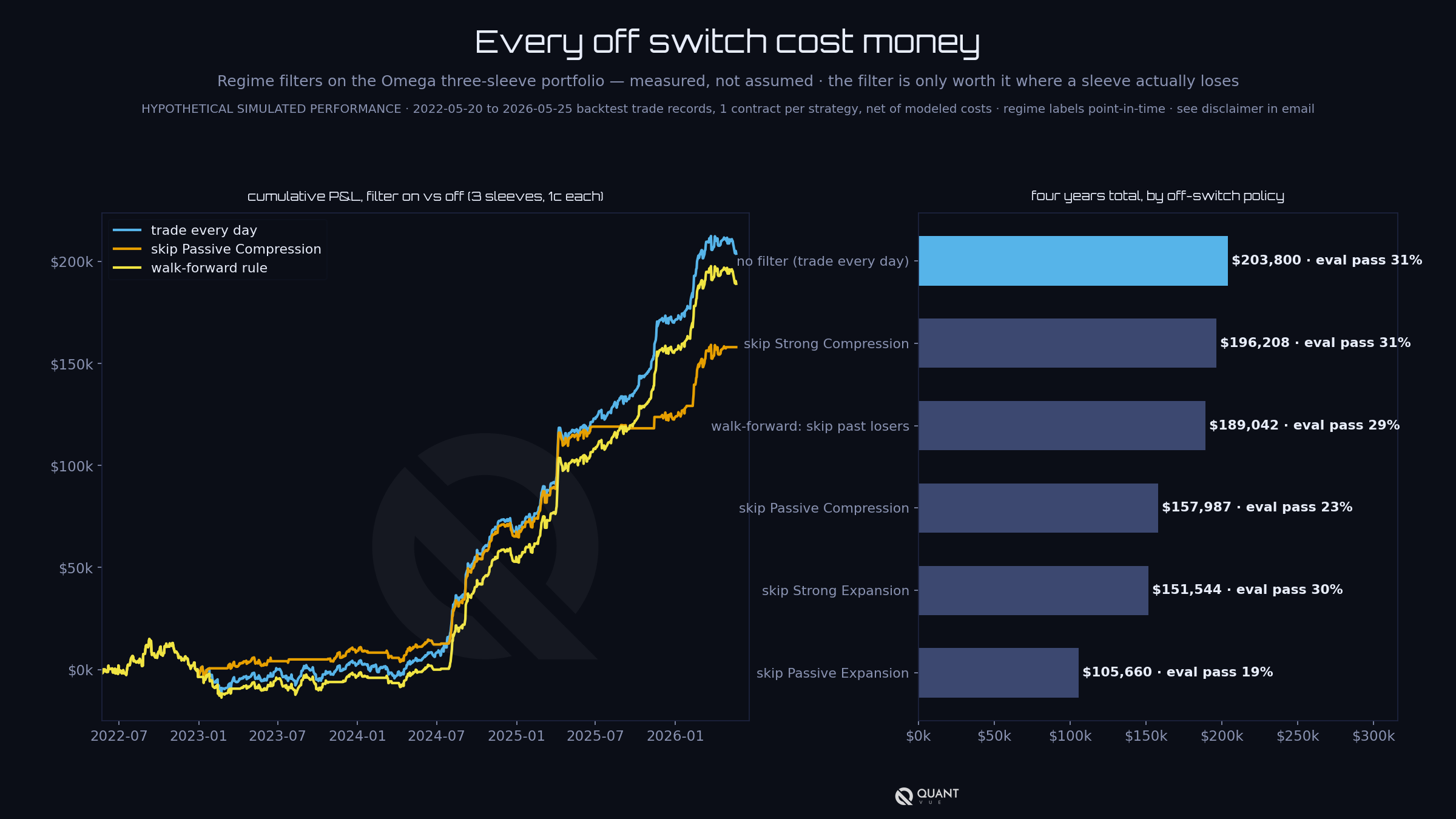
The scoreboard: trading every day made $203,800 over the four years. Skipping Strong Compression, the weakest season, made $196,208. Skipping Passive Compression made $157,987. Keeping only the two expansion regimes made $150,395. The walk-forward rule made $189,042. Every single off switch finished behind doing nothing. We also pushed each version through the evaluation simulator from lesson 13, a $100k account with a $2,500 trailing drawdown and a $6,000 target in 30-day windows, 1,000 runs each. No filter passed 31% of windows. The two-expansions-only filter passed 22%, because an eval clock burns calendar days whether you trade them or not.
Why did the obvious trade fail? Go back to Wednesday's bars. The weak regimes were weak, not negative. $60 a day is a smaller edge, but it is edge, and a switch can only earn its keep where the average day is actually below zero. Across the whole portfolio no regime was. There is exactly one clear win in the whole grid, and Wednesday predicted it: ES, the one sleeve with a genuinely negative regime, improves when it alone skips Passive Compression, total up slightly and its risk-adjusted return up from 1.35 to 1.55. The filter belongs on the sleeve that loses, not on the portfolio that doesn't.
There is a real purchase available here, just be clear about the price tag. Skipping Passive Compression cut the portfolio's worst peak-to-valley drawdown from $26,102 to $18,897, about 28% shallower, and it cost $45,813 of profit and dropped the eval pass rate from 31% to 23% to get it. Calmer equity is a thing you can buy with expected profit. Sometimes that trade is right for an account with a hard drawdown rule. Buying it without pricing it is how most regime filters get installed.
So the lesson of the arc lands in one sentence: the off switch is a parameter, not a belief, and it has to earn its place in a walk-forward test the same way every other parameter does. A selective algorithm already carries its own filter, the conditions it waits for, and stacking a calendar filter on top of that mostly starves it of the days it knew how to use. Measure first. How to read all of it: these are simulations on historical data, hypothetical throughout, medians and totals of distributions, not floors and not offers, and the disclaimer below is the correct description of what you just read. The regime engine that produced every label in this arc runs every morning inside our operation, and the strategies that survived this measuring process are the ones we run. Start below if you want them.
PAST PERFORMANCE IS NOT NECESSARILY INDICATIVE OF FUTURE RESULTS.
This lesson was originally sent to the Algo Creator School email list on August 21, 2026. New lessons go out by email regularly. Join the list at quantvue.io.
Educational content only, not financial advice. Futures trading involves substantial risk of loss and is not suitable for all investors. Individual results vary, and past performance, actual or simulated, does not guarantee future results.


After check out, you will receive a Welcome Email with your login details.
Use these details to Login to our dashboard, where you'll then submit your TradingView or NinjaTrader information.
Access is granted automatically if the form is filled out properly.
If you are having issues with access being granted, please submit a support ticket here.
No. Our core system is designed for those with baseline trading knowledge and live-trading experience. Do not sign up if you're a beginner trader. Intermediate to advanced experience is recommended.
No. There is no algorithm or indicator that can accurately predict with 100% certainty the financial markets.
QuantVue is not responsible for trading losses. Past results are never indicative of future performance. Use QuantVue and trade at your own risk.
Our tools are designed for futures. However, clients can tweak our toolkit to any chart or market.
Most clients use a paid TradingView plan, and the most popular among users is TradingView premium.
You can manage your account in the "My Account" tab or submit a support ticket here and we will process your cancellation immediately!
Our monthly & yearly Pro / Elite plans are backed by a 30-day money back guarantee. If you are not 100% satisfied within 30 days from the time of purchase, you may request a full refund.
Beyond the 30-day period, all sales are final.
The 30 day money back guarantee only applies to first time customers. If you have used our system or had a plan in the past, you are not eligble for a refund. This means if you have used the PRO plan in the past and sign up for ELITE at a later date, you will not be elgible for the refund guarantee and vice versa.
This refund policy does not apply to our ATS program.
See our full refund policy here.
There is a separate money back guarantee for the ATS Program. The ATS refund policy has certain conditions that must be met to receive a full refund.
See our full ATS refund policy here.
The Elite Plan on it's own does not automate into cash or prop firm accounts.
If you want to automate our tools into cash or prop accounts, you can do so via our alert connector QuantLynk here.
Keep in mind QuantLynk is detectable by prop firms, so we recommend using an automation-friendly prop firm.
To automate our tools into prop account undetected, we recommend our ATS Program here.
No. There is no free trial on the ATS program.