

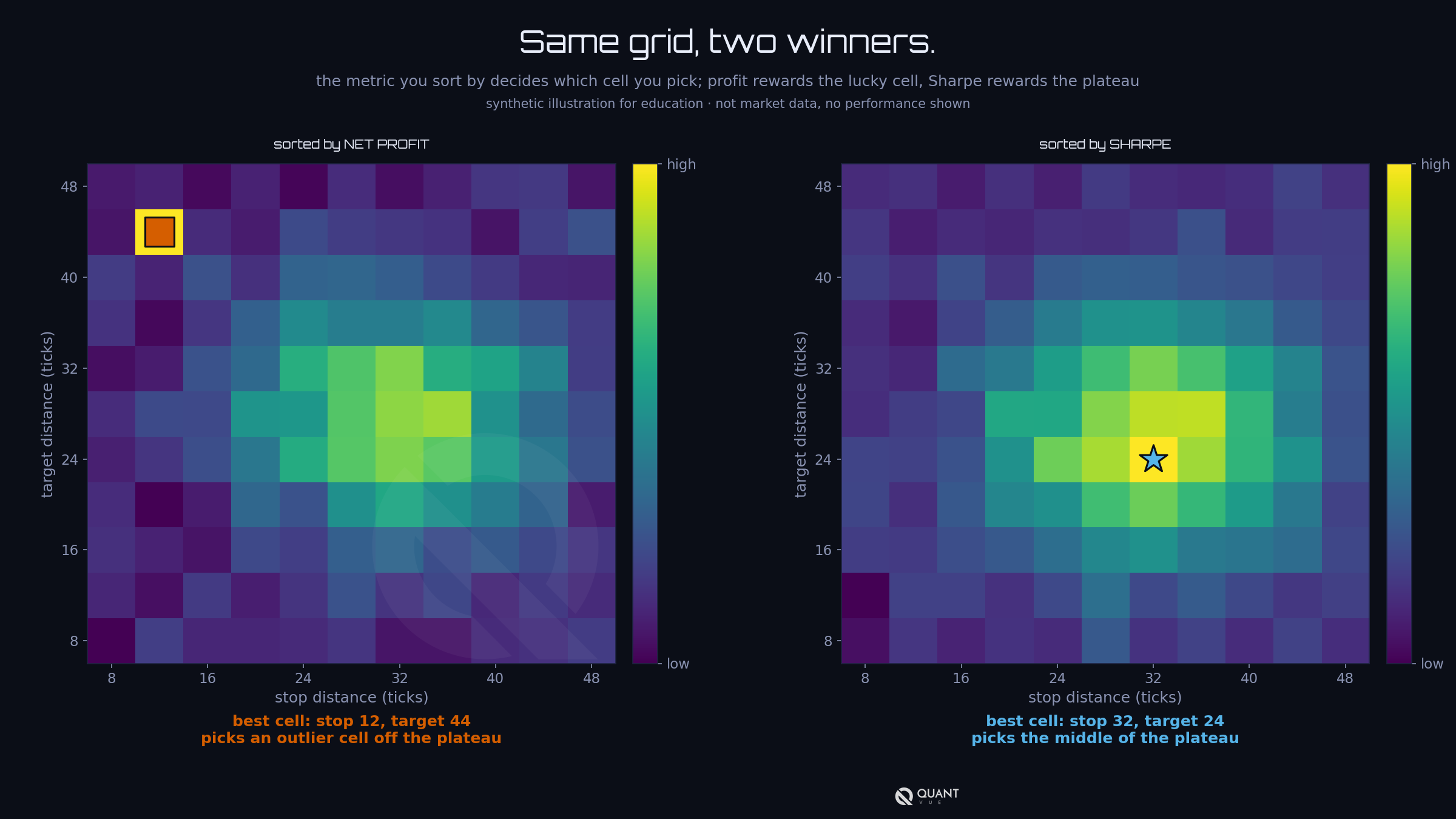
Two sweeps, two plateaus. Monday and Wednesday used win rate and profit curves to read the shape of a sweep and find where the settings are stable. That was a question about one strategy's settings. Today is a different question. You have a strategy sitting on its plateau, or three candidates that each survived the pass, and you have to decide which one deserves capital. The metric you rank them by is what decides that, and most people rank by the wrong one.
The order we use when judging a strategy as a whole. Sharpe ratio and profit factor first. Drawdown second. Net profit and win rate last.
Profit goes last because it is the easiest number to inflate. That's why bottom line profit on an income statement is virtually worthless to determine the value of a company - you can mess with it easily! Double the size and profit doubles. Extend the sample and profit grows. Pick the cell with one lucky outlier trade in it and profit spikes. None of that says anything about whether the next hundred trades will behave. Win rate goes last for Wednesday's reason. It is a property of the target distance and you can buy any win rate you want with a tight enough target. Win rate is a byproduct that helps inform, but it never chooses for us. That is the whole difference from Monday and Wednesday. In a sweep, win rate and profit are shapes you read to find the plateau. In a decision about the strategy as a whole, they are simply interesting information and don't lead the discussion.
Sharpe and profit factor go first because they describe the quality of the return stream with size stripped out. Profit factor is gross wins divided by gross losses, and it tells you how much cushion the strategy has before costs and slippage eat it, which is why it should be read after the doubled-cost test from last Friday, never before. Sharpe tells you how steady the earning is against how much it swings and whether or not it's worth it vs the volatility. Both stay put when you change the contract count, and both fall apart when the edge is an outlier in disguise, which is exactly what you want a first-look metric to do.
Drawdown sits in the middle because it decides whether you are around to collect. A strategy with a great Sharpe and a drawdown you cannot fund, or that breaks a prop firm rule from weeks four and five, is a strategy you will not be running when it pays. It ranks below Sharpe and profit factor because a drawdown number is one path through one sample, and it ranks above profit because profit assumes you survived the path. Drawdowns are better calculated by running Monte Carlos instead of a strict reading of the backtest.
The Sharpe ratio you'll see on most retail trading reports is computed per trade, that is a mean trade result over standard deviation of trade results, scaled by the square root of the trade count. That number answers a narrow question, namely how much edge is in each signal, and it's easy to inflate. It ignores the days the strategy sat out, treats a two-minute scalp and a six-hour hold as equivalent units, and its square-root scaling assumes trades are independent, so a burst of correlated fills gets counted as many independent bets rather than one.
We compute it daily instead. P&L summed by exchange session, a zero on every session with no fills, mean excess return over standard deviation, scaled by the square root of 252. A strategy has to earn its Sharpe across the calendar, including the days it did nothing.
So the full pass, three weeks in one paragraph. Write the sentence with its mechanism and its kill number. Run it through fills you could have gotten. Sweep the stop and the target, refuse to pick from a shape you cannot explain, and land on the wide shoulder. Then judge the strategy that results by Sharpe and profit factor, check the drawdown, and only then look at what it made. Every strategy in ATS 2.0 went through that pass, and the ones that did not survive it are the ones you have never heard of (I have a gigantic folder of dead research).
This lesson was originally sent to the Algo Creator School email list on September 18, 2026. New lessons go out by email regularly. Join the list at quantvue.io.
Educational content only, not financial advice. Futures trading involves substantial risk of loss and is not suitable for all investors. Individual results vary, and past performance, actual or simulated, does not guarantee future results.


After check out, you will receive a Welcome Email with your login details.
Use these details to Login to our dashboard, where you'll then submit your TradingView or NinjaTrader information.
Access is granted automatically if the form is filled out properly.
If you are having issues with access being granted, please submit a support ticket here.
No. Our core system is designed for those with baseline trading knowledge and live-trading experience. Do not sign up if you're a beginner trader. Intermediate to advanced experience is recommended.
No. There is no algorithm or indicator that can accurately predict with 100% certainty the financial markets.
QuantVue is not responsible for trading losses. Past results are never indicative of future performance. Use QuantVue and trade at your own risk.
Our tools are designed for futures. However, clients can tweak our toolkit to any chart or market.
Most clients use a paid TradingView plan, and the most popular among users is TradingView premium.
You can manage your account in the "My Account" tab or submit a support ticket here and we will process your cancellation immediately!
Our monthly & yearly Pro / Elite plans are backed by a 30-day money back guarantee. If you are not 100% satisfied within 30 days from the time of purchase, you may request a full refund.
Beyond the 30-day period, all sales are final.
The 30 day money back guarantee only applies to first time customers. If you have used our system or had a plan in the past, you are not eligble for a refund. This means if you have used the PRO plan in the past and sign up for ELITE at a later date, you will not be elgible for the refund guarantee and vice versa.
This refund policy does not apply to our ATS program.
See our full refund policy here.
There is a separate money back guarantee for the ATS Program. The ATS refund policy has certain conditions that must be met to receive a full refund.
See our full ATS refund policy here.
The Elite Plan on it's own does not automate into cash or prop firm accounts.
If you want to automate our tools into cash or prop accounts, you can do so via our alert connector QuantLynk here.
Keep in mind QuantLynk is detectable by prop firms, so we recommend using an automation-friendly prop firm.
To automate our tools into prop account undetected, we recommend our ATS Program here.
No. There is no free trial on the ATS program.