

Every options trader has heard it. Into expiry, price gets pulled toward the strike with the most open interest. Dealers hedging the biggest line on the board buy the dips and sell the rips, the gamma grows as the clock runs out, and the close lands on the strike. Max pain. Pinning. The magnet. With daily expiries, every session is expiry day now, so if the magnet is real it is tugging on the close five days a week.
It's a good story. It has a mechanism, it has academic papers behind it from the era of monthly expiries, and it has a screenshot for every day it worked. It also has the shape of every belief this series has taken apart. Easy to see after the fact, and nobody has run it against a control. So we ran it.
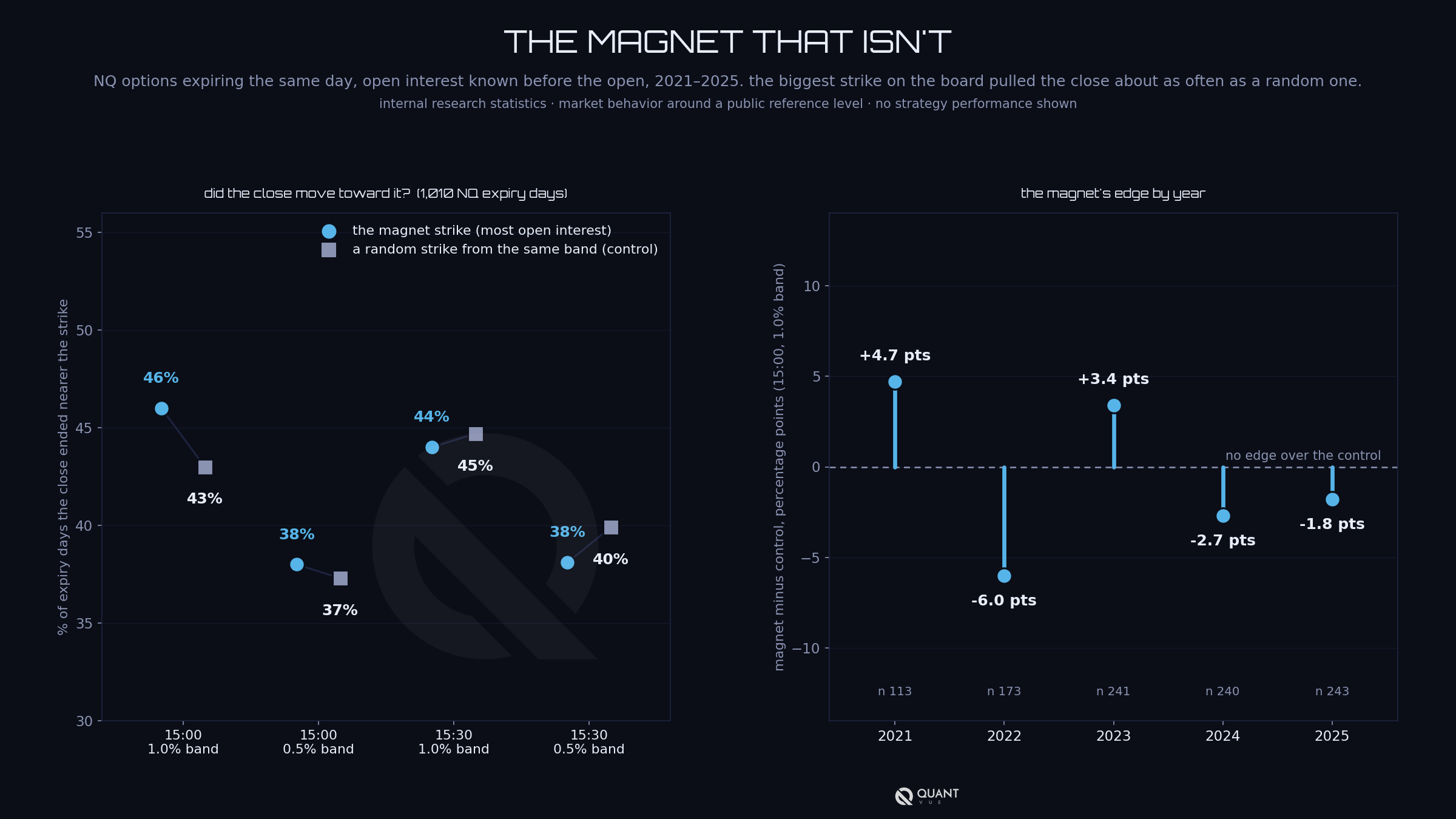
Every NQ option expiring on the day, with its open interest at the prior settlement, so the magnet is known before the open. 1,010 expiry days from spring 2021 through the end of 2025. At 15:00 and again at 15:30, find the strike with the most calls plus puts within half a percent of price, and again within one percent. That's the magnet. Then ask one question. Is the close nearer the magnet than price was when we looked?
#34 said a result is nothing until you know what the world does without the rule in it. Here the control is a random listed strike from the same band, drawn two hundred times per day. A random strike has no gamma pulling anything. If the close lands nearer the magnet more often than it lands nearer a random strike, the magnet is doing work. If the two shares match, the magnet is a strike that happened to be nearby.
They match. At 15:00 with the one percent band, the close moved toward the magnet on 46 percent of days. Toward a random strike, 43 percent. At 15:30, where the gamma would be largest and the pull strongest, 44 percent against 45. The tighter band reads 38 against 37, then 38 against 40. Sixteen cells across anchors, bands and splits, and one of them barely clears the usual bar, at the anchor where the story says the effect should be weakest. By year the gap runs from six points under the control to five over it, with no sign that holds. Max pain itself, the strike that would cost option holders the most, reads 50 percent. A coin flip.
There was one cell that looked like a finding, and it's worth a paragraph because it is exactly the kind of thing that ends up as a strategy. On days where price was already within fifteen basis points of the magnet at 15:00, the close moved toward it only 20 percent of the time, against 38 for the control. Anti-pinning. The magnet repels. Except it doesn't. When price is sitting on the strike, almost any move counts as away, while the random control strike is usually farther off and has room to be approached. Change the question to whether the direction of the move agrees with the direction to the strike, which doesn't care about distance, and the read is 50 percent in every cell. The result lived in the geometry of the measurement, not in the market.
What this doesn't settle is the dealer side. Open interest tells you how big the line is, not who is long the gamma, and the mechanism only pulls when the dealers are. Signing that needs every trade with its aggressor side, which is a different data set and a different afternoon. Open interest alone, the number every max pain page is built from, does not move the close.
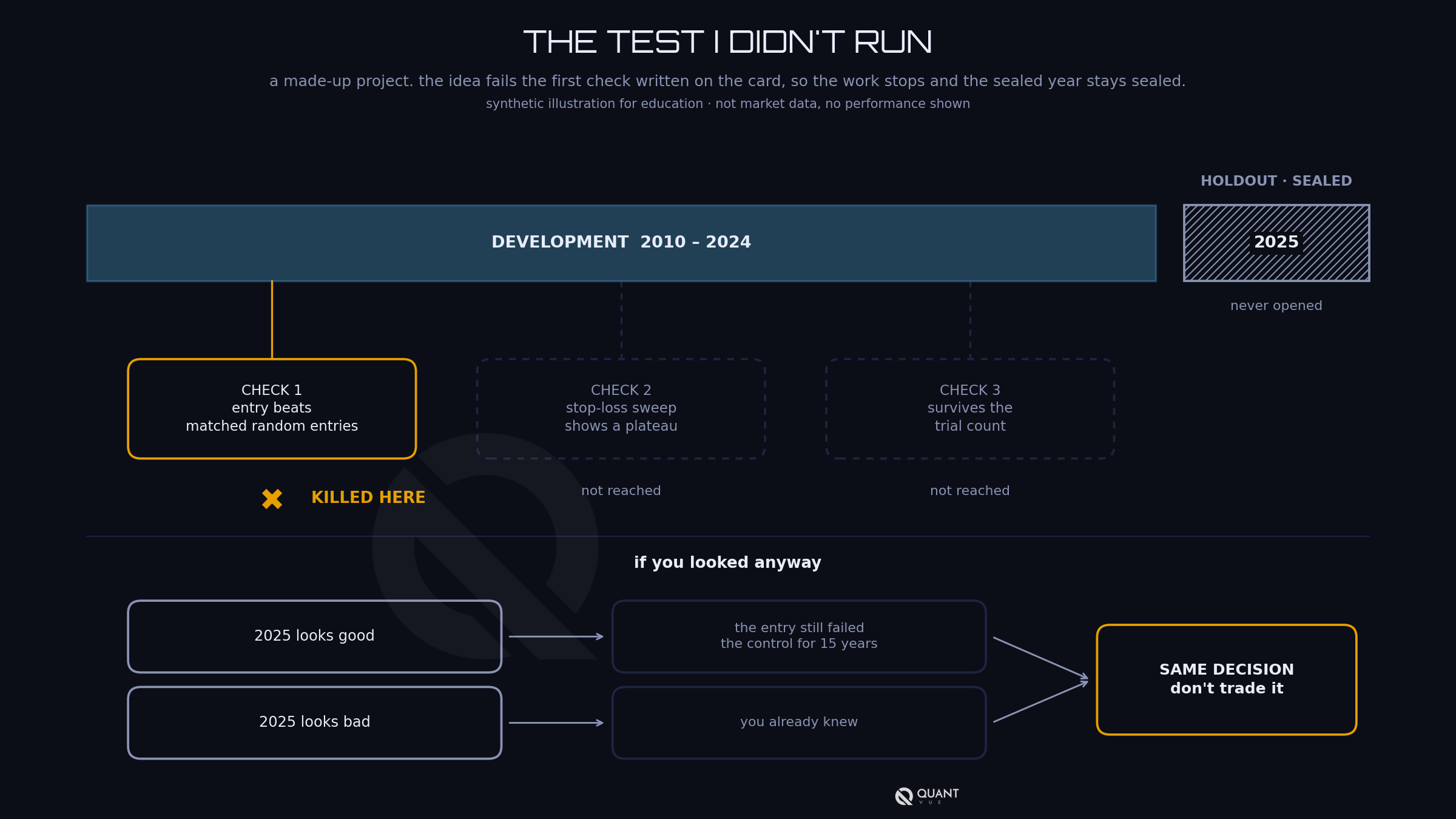
The takeaway is about method. A belief with a mechanism and a screenshot is still a belief until it has a control, and this control took one afternoon and public data. If you trade the close on expiry days off the biggest strike on the board, you are trading a coin flip with a story. Write the hypothesis on the card, name the control, run it, and let the number say no. It's the cheapest no you will ever get.
This lesson was originally sent to the Algo Creator School email list on October 21, 2026. New lessons go out by email regularly. Join the list at quantvue.io.
Educational content only, not financial advice. Futures trading involves substantial risk of loss and is not suitable for all investors. Individual results vary, and past performance, actual or simulated, does not guarantee future results.


After check out, you will receive a Welcome Email with your login details.
Use these details to Login to our dashboard, where you'll then submit your TradingView or NinjaTrader information.
Access is granted automatically if the form is filled out properly.
If you are having issues with access being granted, please submit a support ticket here.
No. Our core system is designed for those with baseline trading knowledge and live-trading experience. Do not sign up if you're a beginner trader. Intermediate to advanced experience is recommended.
No. There is no algorithm or indicator that can accurately predict with 100% certainty the financial markets.
QuantVue is not responsible for trading losses. Past results are never indicative of future performance. Use QuantVue and trade at your own risk.
Our tools are designed for futures. However, clients can tweak our toolkit to any chart or market.
Most clients use a paid TradingView plan, and the most popular among users is TradingView premium.
You can manage your account in the "My Account" tab or submit a support ticket here and we will process your cancellation immediately!
Our monthly & yearly Pro / Elite plans are backed by a 30-day money back guarantee. If you are not 100% satisfied within 30 days from the time of purchase, you may request a full refund.
Beyond the 30-day period, all sales are final.
The 30 day money back guarantee only applies to first time customers. If you have used our system or had a plan in the past, you are not eligble for a refund. This means if you have used the PRO plan in the past and sign up for ELITE at a later date, you will not be elgible for the refund guarantee and vice versa.
This refund policy does not apply to our ATS program.
See our full refund policy here.
There is a separate money back guarantee for the ATS Program. The ATS refund policy has certain conditions that must be met to receive a full refund.
See our full ATS refund policy here.
The Elite Plan on it's own does not automate into cash or prop firm accounts.
If you want to automate our tools into cash or prop accounts, you can do so via our alert connector QuantLynk here.
Keep in mind QuantLynk is detectable by prop firms, so we recommend using an automation-friendly prop firm.
To automate our tools into prop account undetected, we recommend our ATS Program here.
No. There is no free trial on the ATS program.