

A drug company tests a new pill on a thousand patients and seven hundred of them get better. Sounds like a good pill. Then you learn that a second thousand patients got a sugar pill, same bottle, same nurse, same hospital, and six hundred and eighty of them got better too. The pill did almost nothing. People heal on their own, the season changed, the nurse was good. The first group is the test group. The second is the control group. The difference between them is the drug. Everything else is the world doing what it was going to do anyway.
A backtest is a test group with no control. The strategy traded, the equity curve went up, and the report says it worked. Compared to what? Compared to zero, which is the wrong bar. Index futures drifted up for most of the last fifteen years, so any rule that leans long and holds for a while "works." The open is volatile, so any rule that trades the open with a wide target catches big moves. Those are the sugar pill healing the patient. You have to measure the rule against the world without the rule in it.
The trouble is you can't recruit a control group in a market. You can't give Tuesday a placebo. You can't re-run last March with the signal withheld. There is one history and it already happened. So the control has to be built, by hand, from the same data, and it has to look like your strategy in every way except the one thing your strategy claims to know.
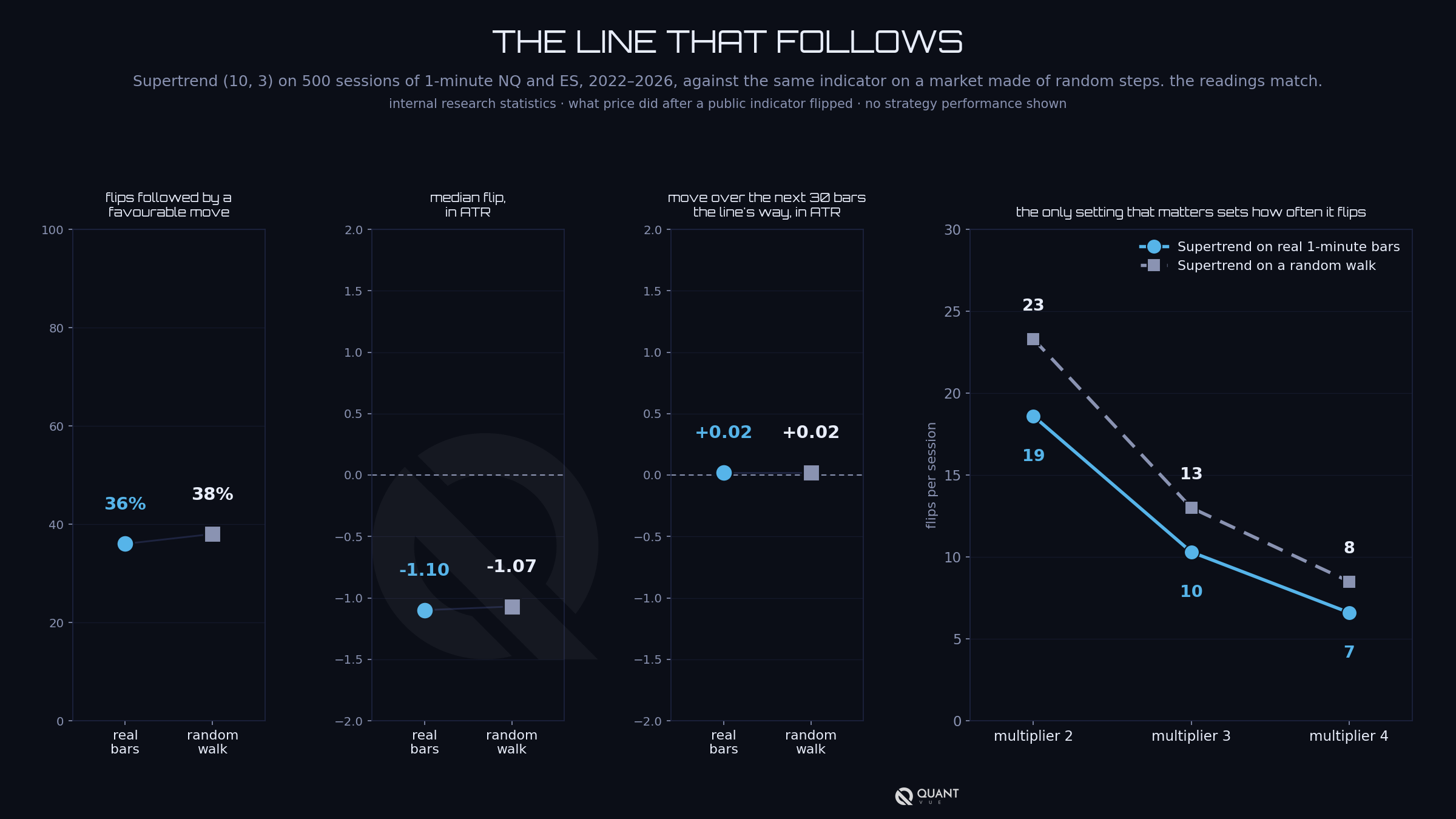
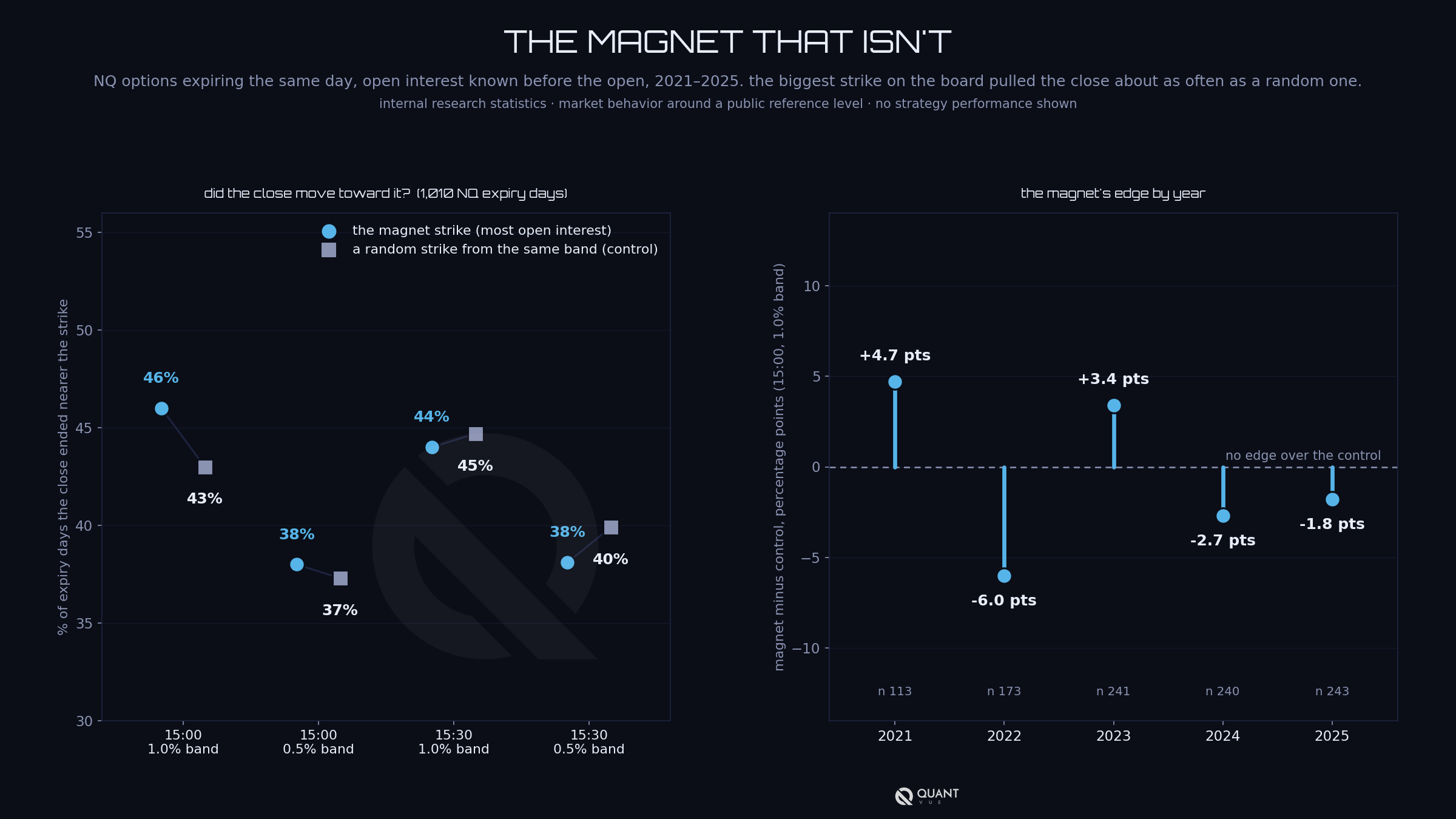
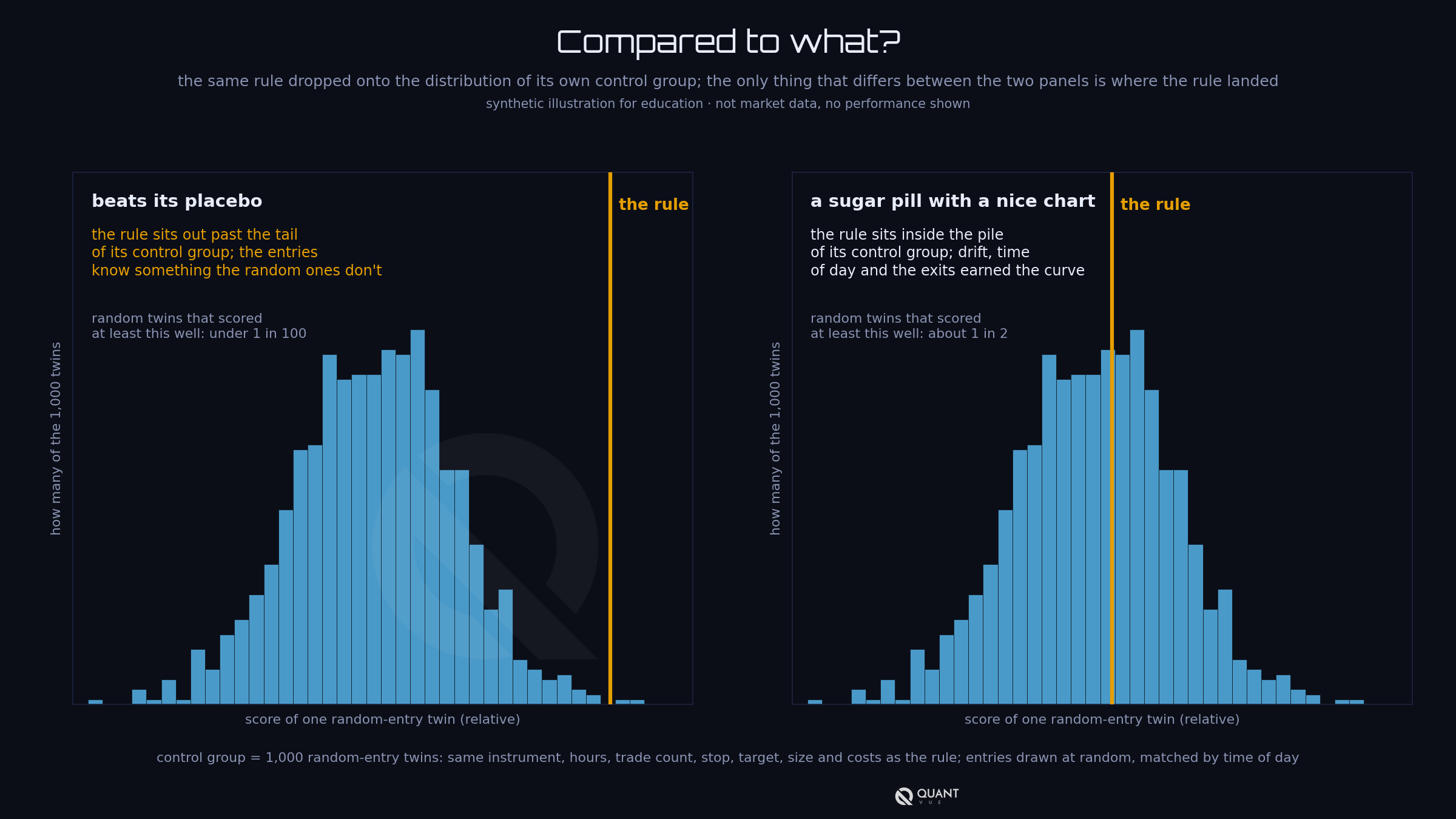
Same instrument. Same session hours. Same number of trades. Same stop, same target, same holding time, same size, same costs. The entries are the only thing that changes. For the control they're drawn at random, matched to your rule's trades by time of day, since the open and lunch are different animals and #8 already showed what a lazy control does to a study. Run that random twin a thousand times, because one random run is as much a sample of one as your backtest is, and you get a distribution of what a strategy with your footprint and no information earns. Then you drop your real result onto that distribution and look where it lands.
If it sits out in the tail, the rule knows something the random entries don't. If it sits in the middle of the pile, your strategy is a sugar pill with a nice chart, and the drift, the time of day and the exit logic earned every dollar of that curve. Most "systems" land in the middle. I have landed in the middle more times than I'd like to admit, and every one of those would have gone live if I'd only compared it to zero.
One random twin isn't the whole set. A second control keeps your exact signal timestamps and shifts them all by a day, or shuffles them, so the frequency and the clustering stay but the information is gone. A third swaps the clever part of the rule for something arbitrary, the way #8 gave an invented line the identical touch logic VWAP got. A fourth, for anything directional, is holding the contract over the same window at the same exposure. If your long-only rule made less than sitting in the trade, the rule was in the way. Each control answers a different question, and a strategy that survives all four has earned a sweep.
The discipline underneath all of it is one line. Same code path, one variable changed. The moment your control uses different hours, a different stop, a different cost model or a different sample, you've compared two experiments instead of one, and whatever difference you find could have come from any of it.
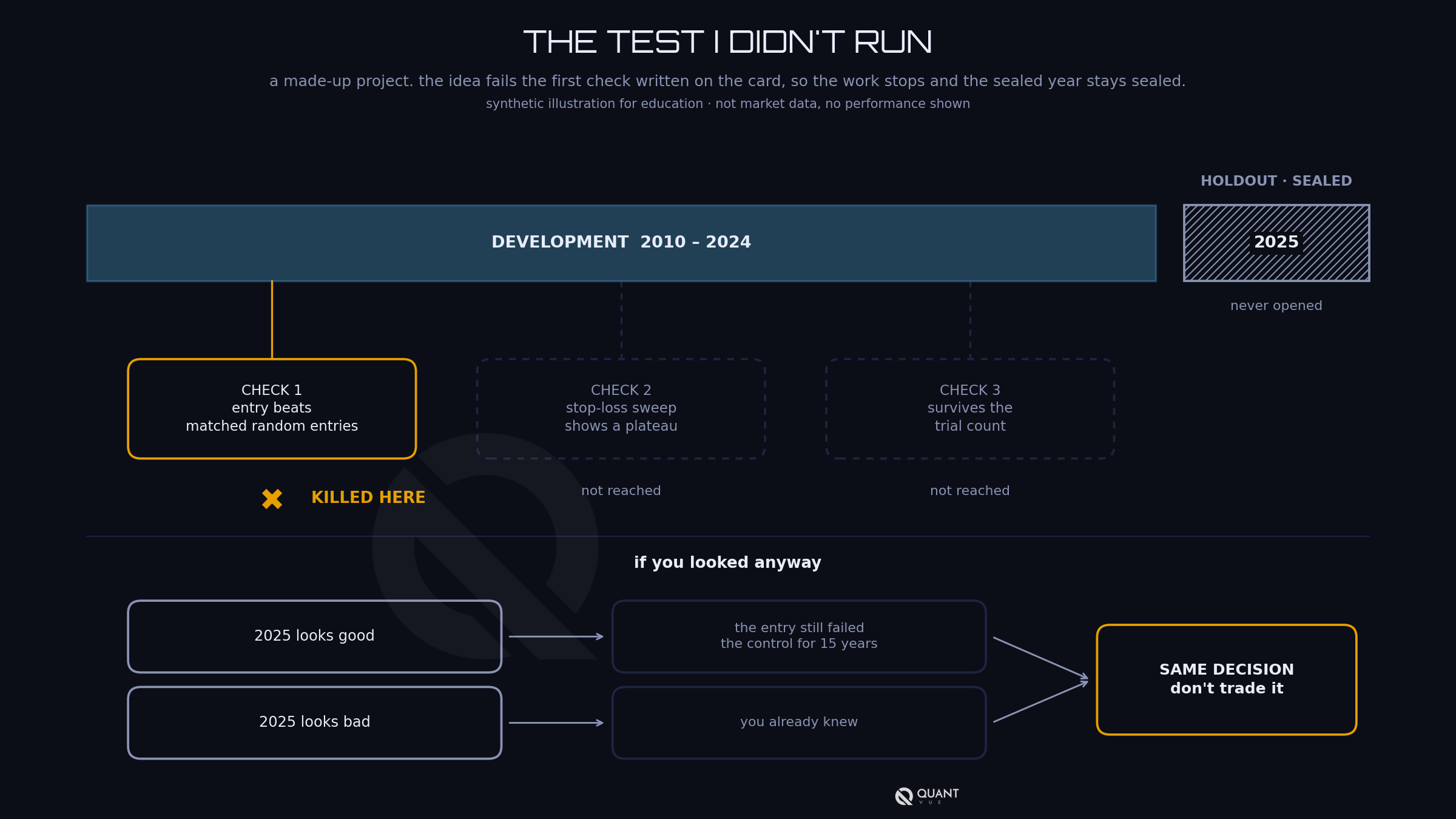
The bar is better than its own placebo, by more than the noise, after you've counted the trials from #4. Write that on the hypothesis card before the first test and the backtest can't flatter you.
Every strategy we run goes through its controls before it gets anywhere near a sweep. A rule that can't beat its own random twin never makes it to the settings stage, because there is nothing there to set.
Wednesday is the toolbox. Every library we run this on, and what each one is for.
This lesson was originally sent to the Algo Creator School email list on October 12, 2026. New lessons go out by email regularly. Join the list at quantvue.io.
Educational content only, not financial advice. Futures trading involves substantial risk of loss and is not suitable for all investors. Individual results vary, and past performance, actual or simulated, does not guarantee future results.


After check out, you will receive a Welcome Email with your login details.
Use these details to Login to our dashboard, where you'll then submit your TradingView or NinjaTrader information.
Access is granted automatically if the form is filled out properly.
If you are having issues with access being granted, please submit a support ticket here.
No. Our core system is designed for those with baseline trading knowledge and live-trading experience. Do not sign up if you're a beginner trader. Intermediate to advanced experience is recommended.
No. There is no algorithm or indicator that can accurately predict with 100% certainty the financial markets.
QuantVue is not responsible for trading losses. Past results are never indicative of future performance. Use QuantVue and trade at your own risk.
Our tools are designed for futures. However, clients can tweak our toolkit to any chart or market.
Most clients use a paid TradingView plan, and the most popular among users is TradingView premium.
You can manage your account in the "My Account" tab or submit a support ticket here and we will process your cancellation immediately!
Our monthly & yearly Pro / Elite plans are backed by a 30-day money back guarantee. If you are not 100% satisfied within 30 days from the time of purchase, you may request a full refund.
Beyond the 30-day period, all sales are final.
The 30 day money back guarantee only applies to first time customers. If you have used our system or had a plan in the past, you are not eligble for a refund. This means if you have used the PRO plan in the past and sign up for ELITE at a later date, you will not be elgible for the refund guarantee and vice versa.
This refund policy does not apply to our ATS program.
See our full refund policy here.
There is a separate money back guarantee for the ATS Program. The ATS refund policy has certain conditions that must be met to receive a full refund.
See our full ATS refund policy here.
The Elite Plan on it's own does not automate into cash or prop firm accounts.
If you want to automate our tools into cash or prop accounts, you can do so via our alert connector QuantLynk here.
Keep in mind QuantLynk is detectable by prop firms, so we recommend using an automation-friendly prop firm.
To automate our tools into prop account undetected, we recommend our ATS Program here.
No. There is no free trial on the ATS program.