

Two weeks ago we spent three emails on how strategies die. Today, where a living one starts. Indicators, chart patterns and backtests come later. It starts as a sentence you can be wrong about. And frankly, you will be wrong about quite often.
There are three places a real hypothesis comes from.
The first is an event you can point to on the tape and watch repeat. Not a shape you remember seeing, an event you can define so precisely that a script could find every instance of it without you in the room.
The second is a counterparty. Someone has to be on the losing side of your trade and they have to keep coming back. Hedgers rolling on a schedule, funds rebalancing at the close, stops stacked under an obvious low, a slow participant repricing a few seconds after everyone else.
The third is a structural fact of the market itself. The open is an auction. Settlement is a fixed time. Options expire on known dates. Roll week moves the volume. None of those are opinions and all of them shape order flow.
The best hypotheses touch all three. You saw the event, you can name who pays for it, and you can explain why the market's structure makes them pay.
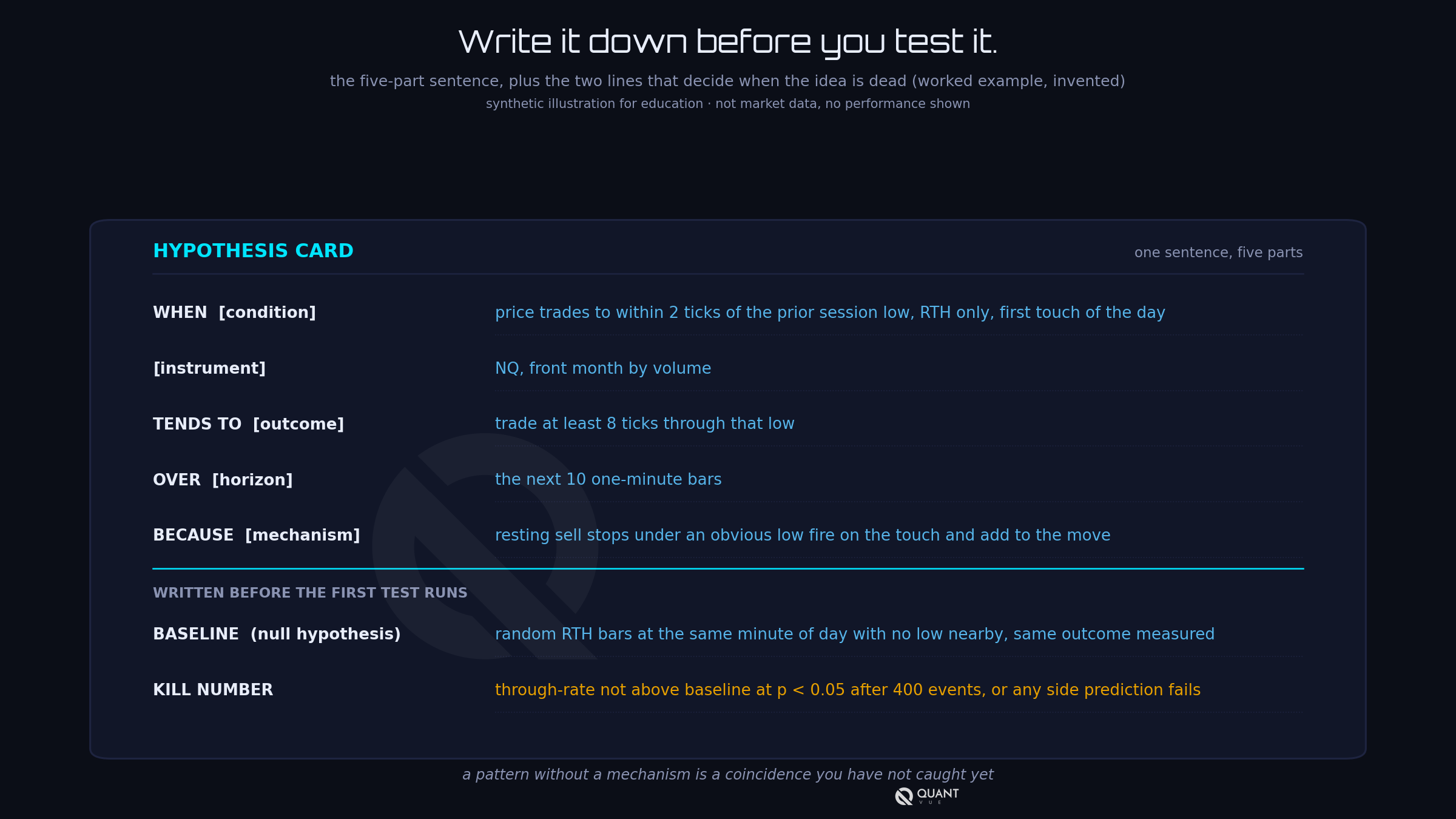
Now write it down in one sentence with five parts. When [a condition you can measure], [an instrument] tends to [an outcome you can measure] over [a horizon], because [a mechanism]. Every word in the first four brackets gets a definition before any test runs, the way we defined touch, approach and bounce in week three. The fifth bracket is the one almost nobody writes, and it is the one that keeps the strategy alive. A pattern without a mechanism is just a coincidence that you can't test properly.
Some sentences that look like hypotheses and are not. "The market respects round numbers." No condition, no horizon, no mechanism, and respects is not a measurement. "My indicator works." An indicator is a filter on price. It is an input to a hypothesis, never the hypothesis. "Buy the dip." Which dip, on what, held for how long, and who is selling it to you?
Before the first test, two more lines go on the card.
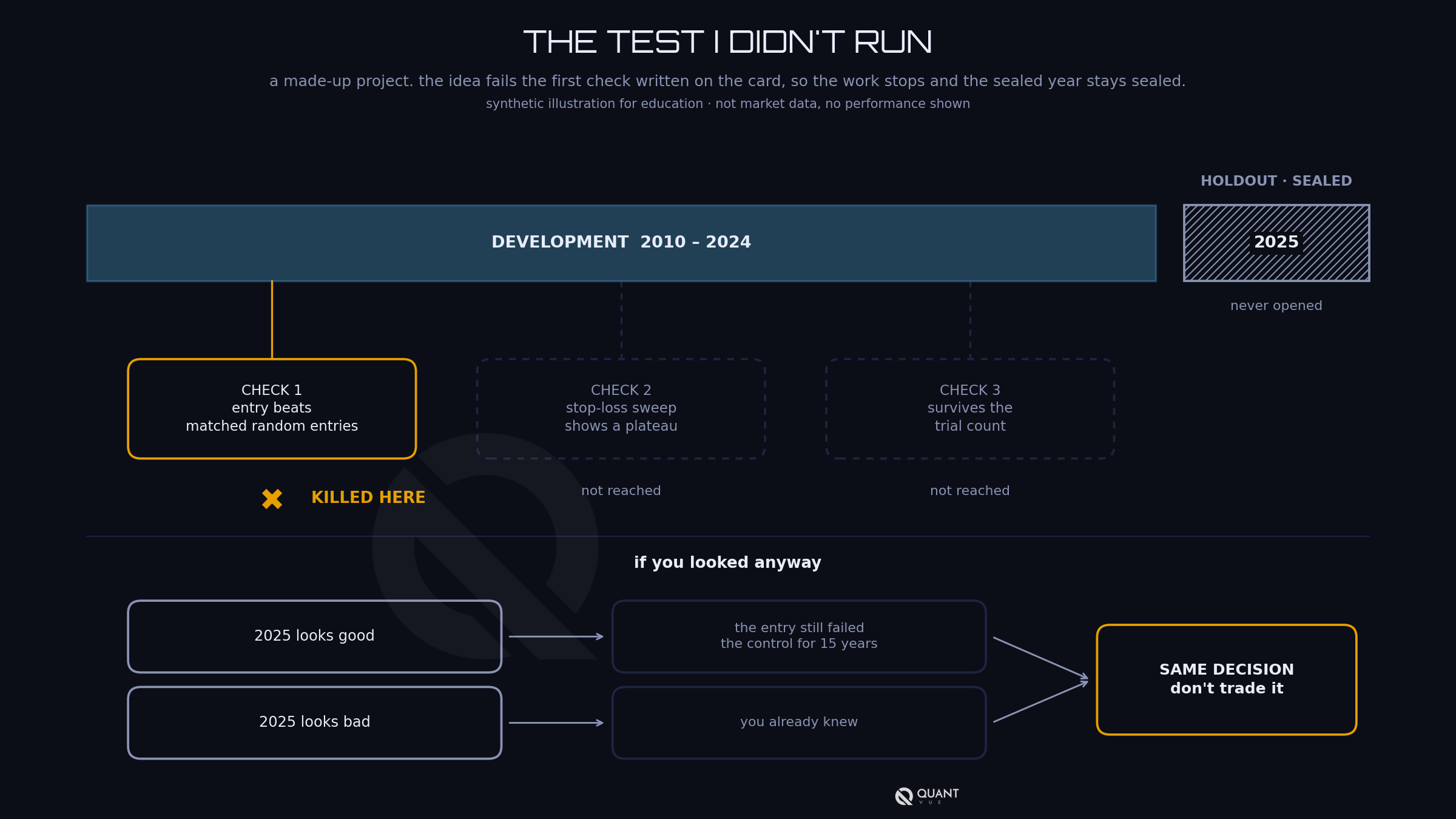
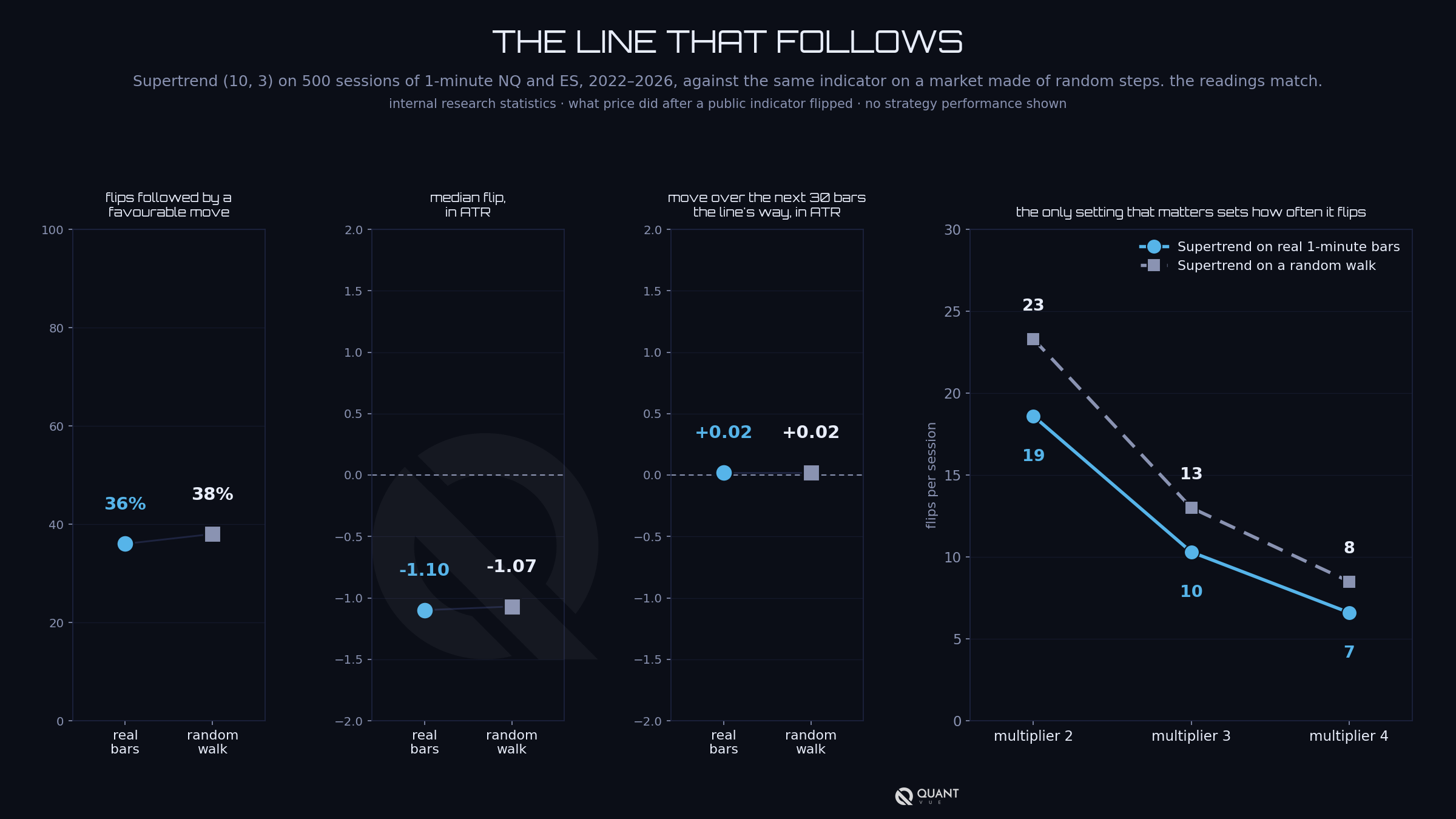
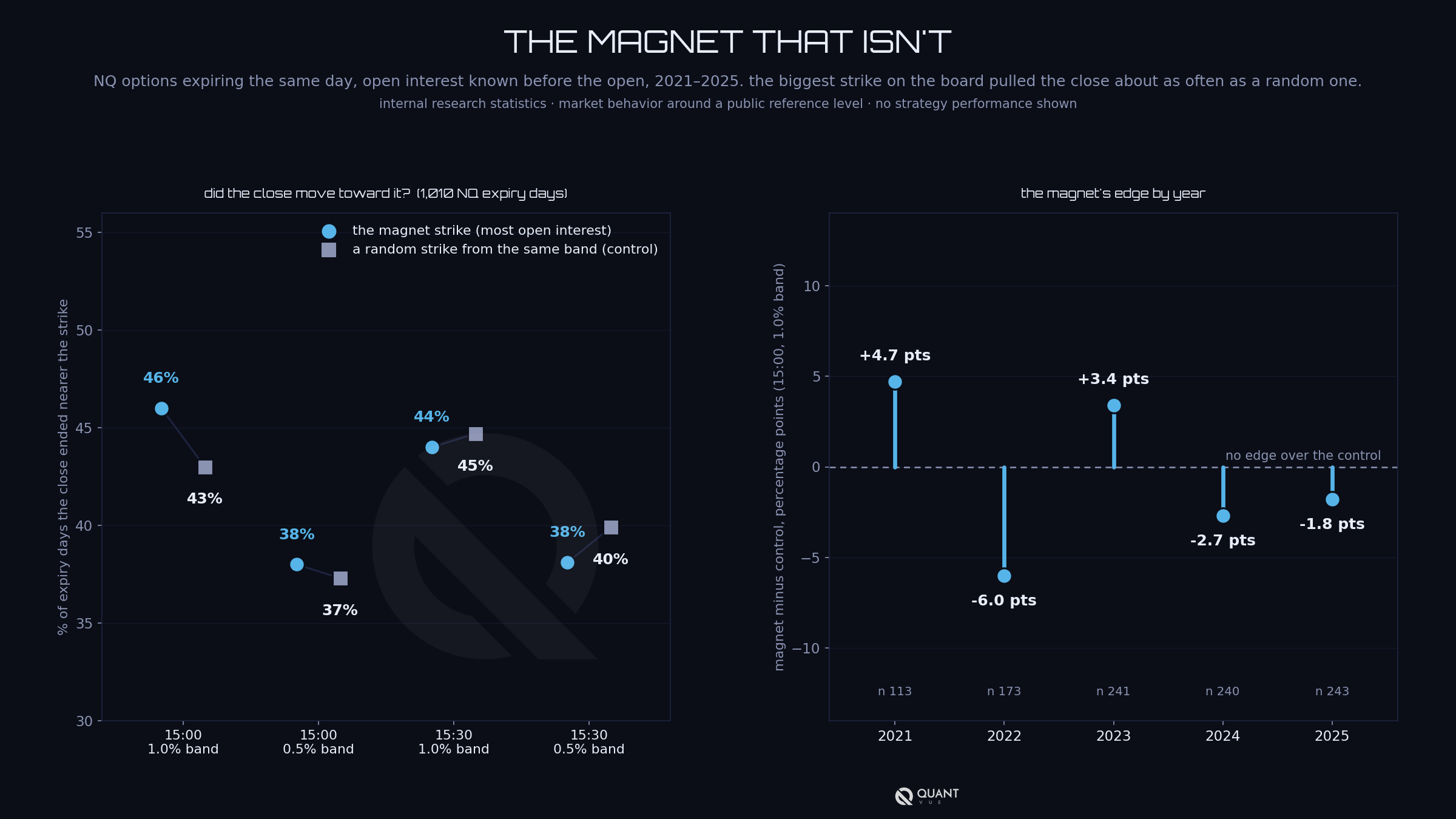
The baseline (the null hypothesis), meaning what the outcome looks like when the condition is absent, because noisy markets do everything sometimes. A lot of people, if they haven't had formal training in data science, fail to recognize this part. Normal market noise can make many ideas appear to be profitable over a short period of time and we need a baseline to measure against (significance testing).
And the kill number (failure to reject the null hypothesis), the result that makes you drop the idea. Write it before you see any data. If you write it after, you will write whatever number the data cleared. This is usually a p-value or a measurable metric like a Sharpe.
One more test, and it is the one that separates edges from curve fits. If the mechanism is real, it predicts things beyond your trade. A stop-cluster hypothesis predicts a volume spike at the level, a fast move through it, and a slower move after. Check the side predictions. When the trade pattern holds but the side predictions fail, you found a pattern that happened to be in your sample, and week seven told you what happens to those. This is the first thing I'll do before continuing to test. If I can't find any side predictions, then I'm probably just looking at noise and I'll go through testing just to fail to reject the null. And that's boring.
After we've done these things we have a hypothesis. Now, it can be tested thoroughly. And in the end, you will likely end up tossing it in the trash can because real edges are extraordinarily rare.
On Friday we'll talk about how your backtest can secretly lie to you.
This lesson was originally sent to the Algo Creator School email list on September 9, 2026. New lessons go out by email regularly. Join the list at quantvue.io.
Educational content only, not financial advice. Futures trading involves substantial risk of loss and is not suitable for all investors. Individual results vary, and past performance, actual or simulated, does not guarantee future results.


After check out, you will receive a Welcome Email with your login details.
Use these details to Login to our dashboard, where you'll then submit your TradingView or NinjaTrader information.
Access is granted automatically if the form is filled out properly.
If you are having issues with access being granted, please submit a support ticket here.
No. Our core system is designed for those with baseline trading knowledge and live-trading experience. Do not sign up if you're a beginner trader. Intermediate to advanced experience is recommended.
No. There is no algorithm or indicator that can accurately predict with 100% certainty the financial markets.
QuantVue is not responsible for trading losses. Past results are never indicative of future performance. Use QuantVue and trade at your own risk.
Our tools are designed for futures. However, clients can tweak our toolkit to any chart or market.
Most clients use a paid TradingView plan, and the most popular among users is TradingView premium.
You can manage your account in the "My Account" tab or submit a support ticket here and we will process your cancellation immediately!
Our monthly & yearly Pro / Elite plans are backed by a 30-day money back guarantee. If you are not 100% satisfied within 30 days from the time of purchase, you may request a full refund.
Beyond the 30-day period, all sales are final.
The 30 day money back guarantee only applies to first time customers. If you have used our system or had a plan in the past, you are not eligble for a refund. This means if you have used the PRO plan in the past and sign up for ELITE at a later date, you will not be elgible for the refund guarantee and vice versa.
This refund policy does not apply to our ATS program.
See our full refund policy here.
There is a separate money back guarantee for the ATS Program. The ATS refund policy has certain conditions that must be met to receive a full refund.
See our full ATS refund policy here.
The Elite Plan on it's own does not automate into cash or prop firm accounts.
If you want to automate our tools into cash or prop accounts, you can do so via our alert connector QuantLynk here.
Keep in mind QuantLynk is detectable by prop firms, so we recommend using an automation-friendly prop firm.
To automate our tools into prop account undetected, we recommend our ATS Program here.
No. There is no free trial on the ATS program.