

This week is about something nobody selling a course will tell you. Strategies die.
Every edge is born on the day someone notices a pattern in the market with a higher-than-coinflip correlation, and the moment enough people find out about it, the edge has a funeral as well. Today, the life cycle and why it is physics rather than bad luck. Wednesday, the published research that measured the decay. Friday, what that means for anything you can Google, anything an AI can write for you, and how we build so ours stay alive.
Start with where an edge comes from. A market pays you for taking the other side of someone who has to trade. Hedgers rolling a position, funds rebalancing on a schedule, retail chasing a move at the worst moment, a slow participant who reacts to news a few seconds late. Every durable edge maps to a counterparty and a reason they keep showing up. If you cannot name who is losing to your strategy and why they keep doing it, you have a curve fit, and we spent weeks four through six on what happens to those.
Why do you think hedge funds purchase order flow data from Robinhood? It's specifically so they can exploit retail traders and crush their edges.
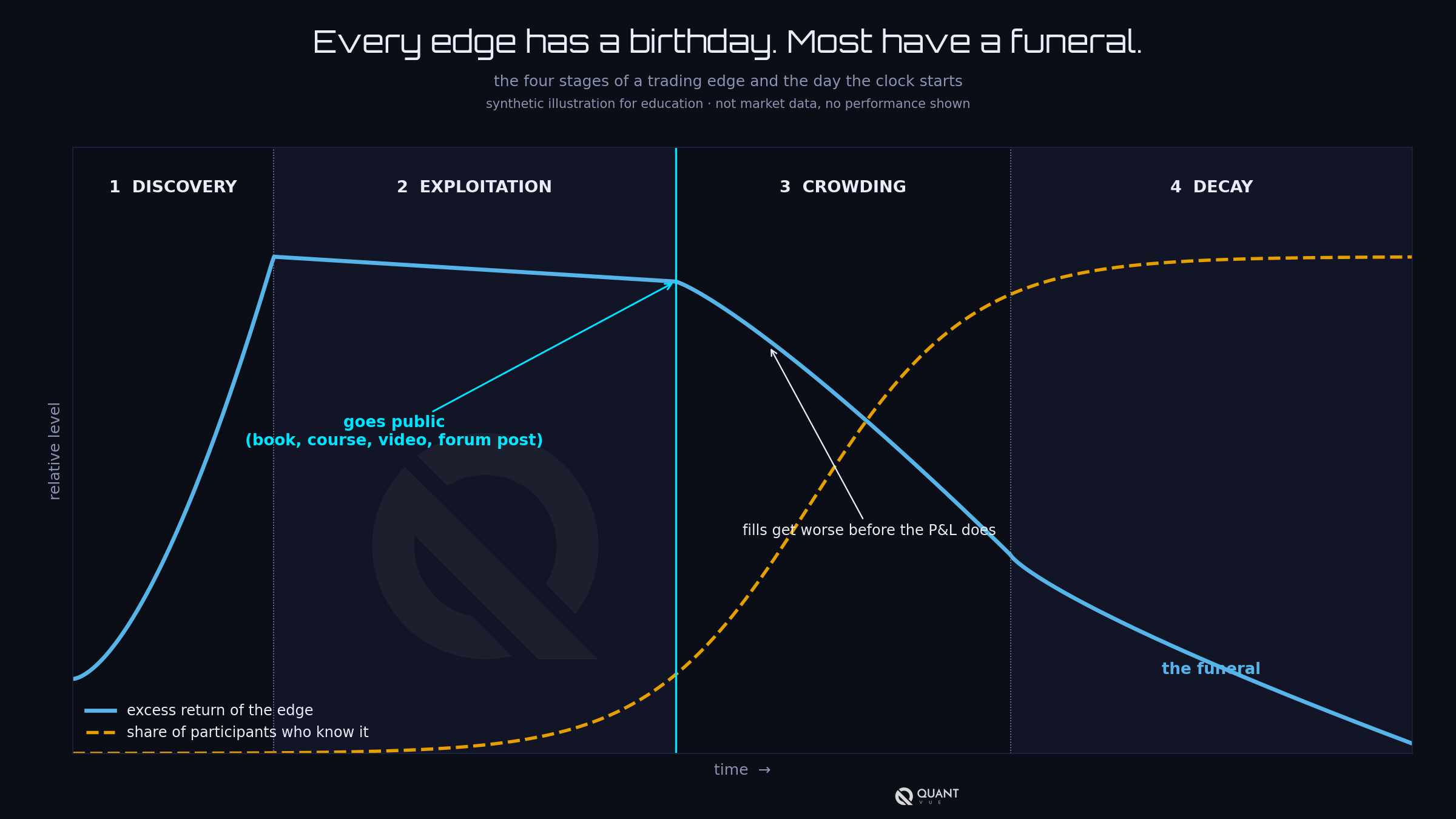
Now the life cycle. Discovery, when one trader or one desk sees the pattern and the returns are fat because nobody else is competing for the fill. Exploitation, when a handful of people trade it and it holds up for X amount of time. Crowding, when it goes public, a book, a course, a YouTube series, a forum post that gets shared, and the number of people placing the same order at the same moment climbs. Decay, when the counterparty is gone. Either the losing side learned, or the crowd now trades against itself and the excess return goes to zero, then below zero once you count slippage.
Discovery -> Exploitation -> Crowding -> Decay
In the crowding stage your fills get worse first. The limit order that used to fill now gets skipped because ten other orders sit ahead of it at the same price. The breakout you enter gets front-run by faster participants who read the same book. Win rate holds for a while, average win shrinks, and a strategy that was paying you slowly becomes a strategy that pays the people who got there first. By the time the equity curve rolls over, the strategy was dead months ago. You just didn't notice.
Note this is a separate phenomena from a number of people using the same proprietary strategy that has not been revealed, but the tape is thin. The edge will not decay to nothing there, because the edge is not revealed to the counter party. The edge is still very real, although P&L can drop.
The uncomfortable conclusion is that publication is the event that causes the star's collapse. A strategy in a bestseller is a strategy with its counterparty removed, because the counterparty read the book too. On Wednesday we put a number on that with the study that tracked 97 published edges through their own funerals.
This lesson was originally sent to the Algo Creator School email list on August 31, 2026. New lessons go out by email regularly. Join the list at quantvue.io.
Educational content only, not financial advice. Futures trading involves substantial risk of loss and is not suitable for all investors. Individual results vary, and past performance, actual or simulated, does not guarantee future results.


After check out, you will receive a Welcome Email with your login details.
Use these details to Login to our dashboard, where you'll then submit your TradingView or NinjaTrader information.
Access is granted automatically if the form is filled out properly.
If you are having issues with access being granted, please submit a support ticket here.
No. Our core system is designed for those with baseline trading knowledge and live-trading experience. Do not sign up if you're a beginner trader. Intermediate to advanced experience is recommended.
No. There is no algorithm or indicator that can accurately predict with 100% certainty the financial markets.
QuantVue is not responsible for trading losses. Past results are never indicative of future performance. Use QuantVue and trade at your own risk.
Our tools are designed for futures. However, clients can tweak our toolkit to any chart or market.
Most clients use a paid TradingView plan, and the most popular among users is TradingView premium.
You can manage your account in the "My Account" tab or submit a support ticket here and we will process your cancellation immediately!
Our monthly & yearly Pro / Elite plans are backed by a 30-day money back guarantee. If you are not 100% satisfied within 30 days from the time of purchase, you may request a full refund.
Beyond the 30-day period, all sales are final.
The 30 day money back guarantee only applies to first time customers. If you have used our system or had a plan in the past, you are not eligble for a refund. This means if you have used the PRO plan in the past and sign up for ELITE at a later date, you will not be elgible for the refund guarantee and vice versa.
This refund policy does not apply to our ATS program.
See our full refund policy here.
There is a separate money back guarantee for the ATS Program. The ATS refund policy has certain conditions that must be met to receive a full refund.
See our full ATS refund policy here.
The Elite Plan on it's own does not automate into cash or prop firm accounts.
If you want to automate our tools into cash or prop accounts, you can do so via our alert connector QuantLynk here.
Keep in mind QuantLynk is detectable by prop firms, so we recommend using an automation-friendly prop firm.
To automate our tools into prop account undetected, we recommend our ATS Program here.
No. There is no free trial on the ATS program.