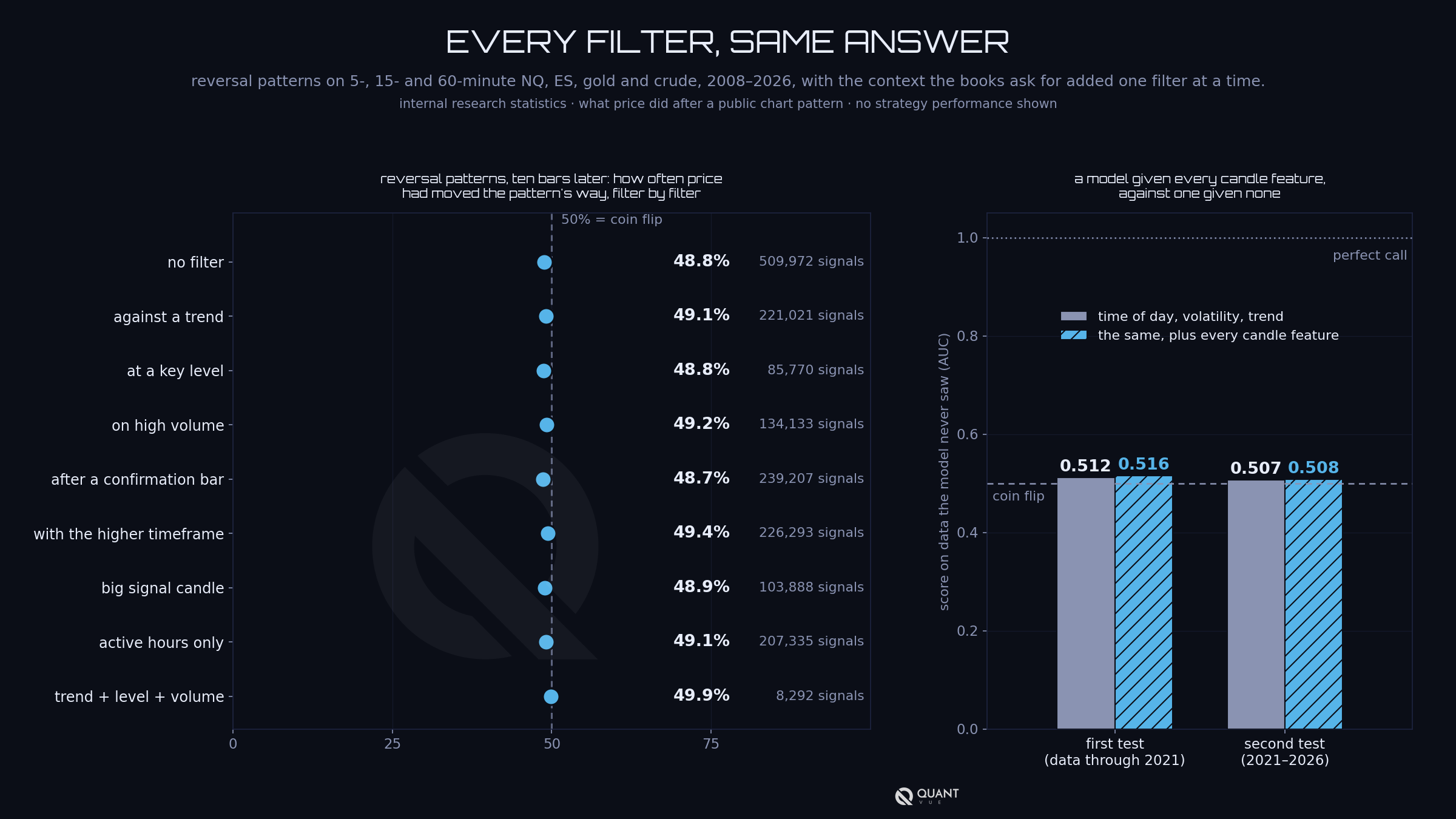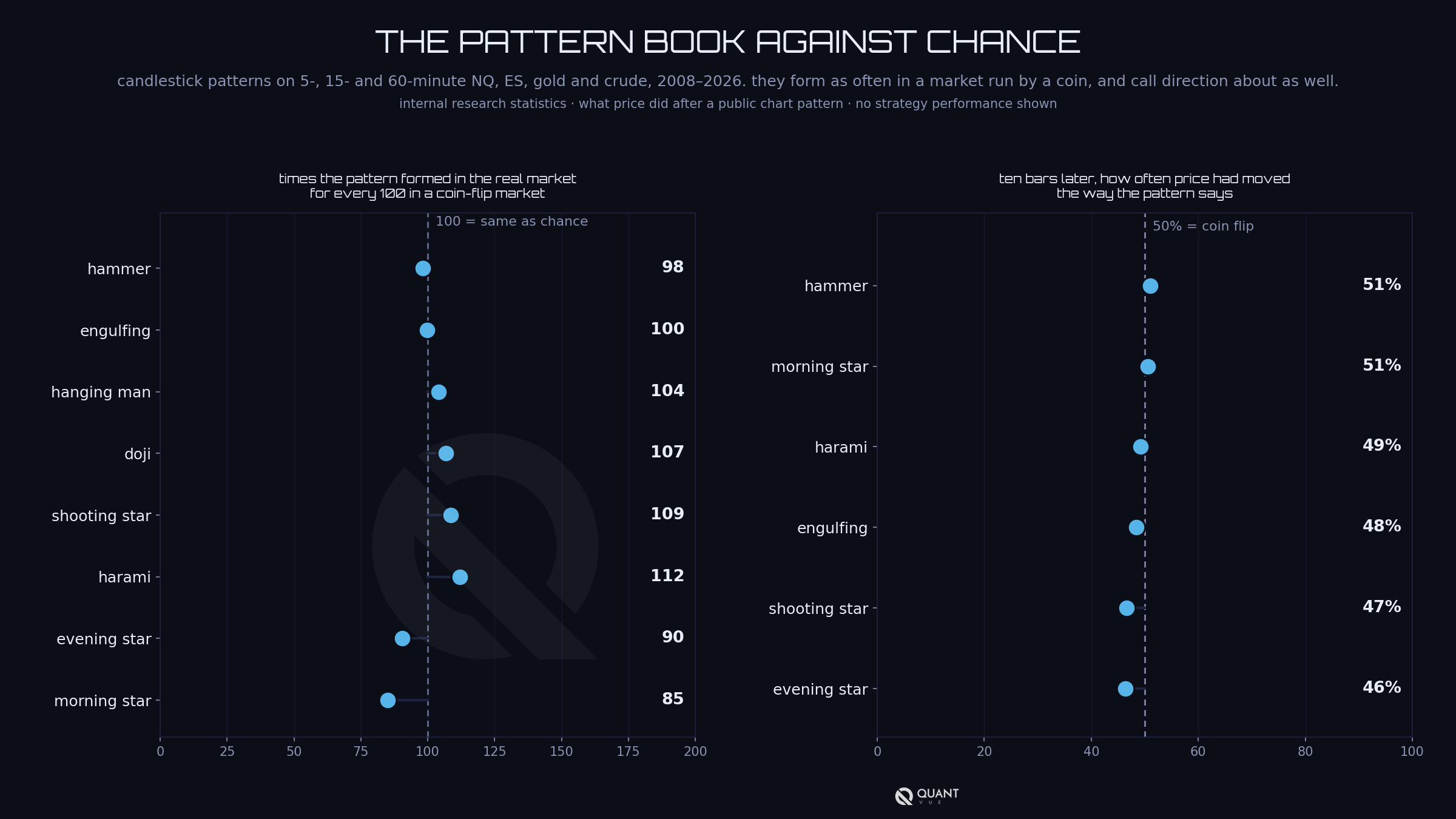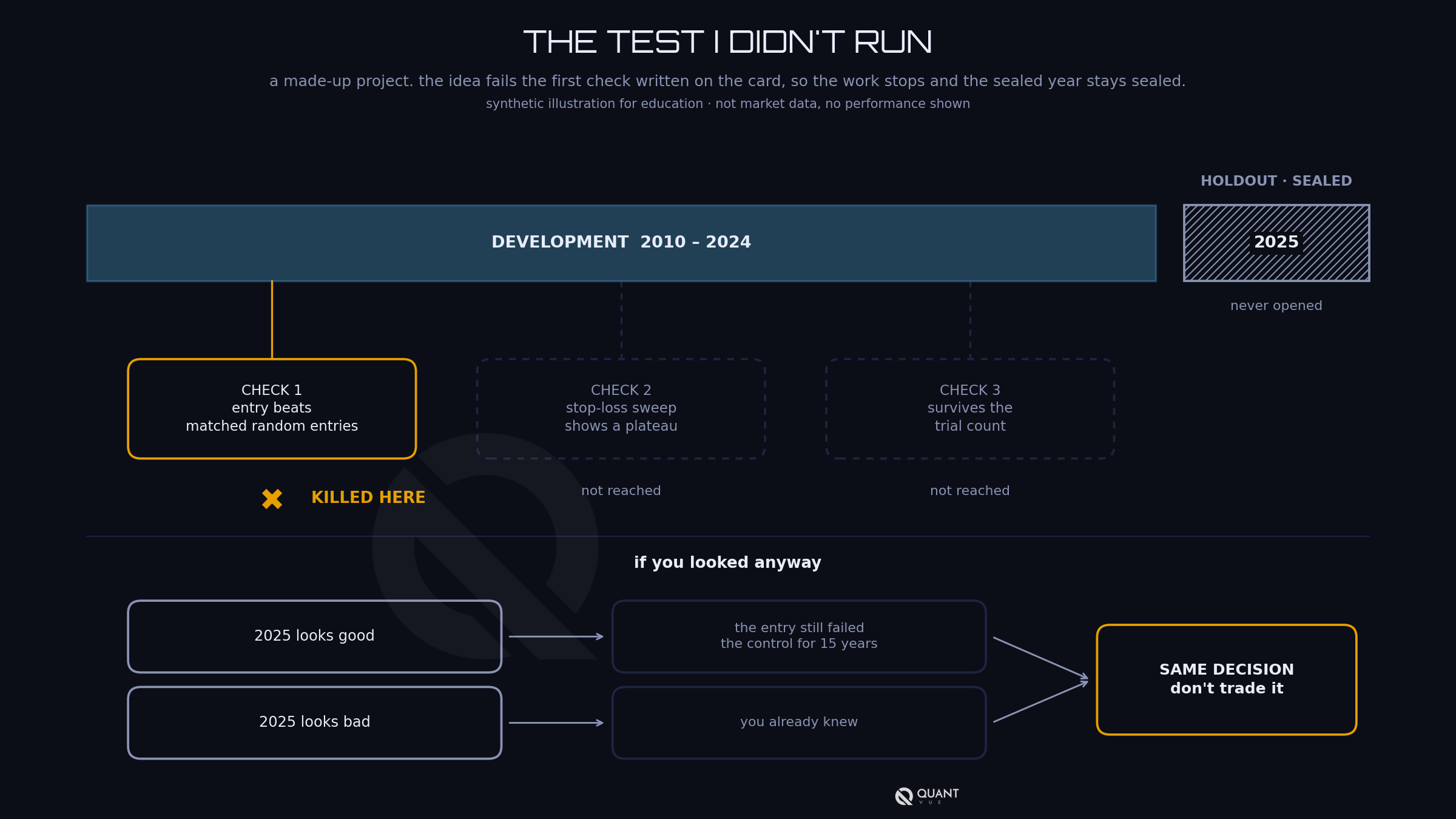


Wednesday was "it was obvious." Today is its smarter cousin. "It should have waited for confirmation." "It should have checked the 15 minute trend." "It shouldn't trade the first ten minutes." These sound like analysis. They come with a reason, and sometimes with a screenshot of the exact indicator that would have saved the trade. Sometimes this is an old school lagging indicator like a MACD, sometimes it's a trendy one that lots of people purchase, sometimes it's something Claude whipped up for the user. Honestly, all of those are lagging and none of them matter.
Each one is a filter. A filter is a rule, a rule is a hypothesis, and the lesson on the hypothesis card was about where a hypothesis is allowed to come from. It comes from a mechanism you can write down, and it gets tested against the full trade list before it goes anywhere near the code. "It should have waited for X" skips all of that. It came from one trade. It was chosen because it would have prevented that one trade. And you haven't checked what it does to the other 399.
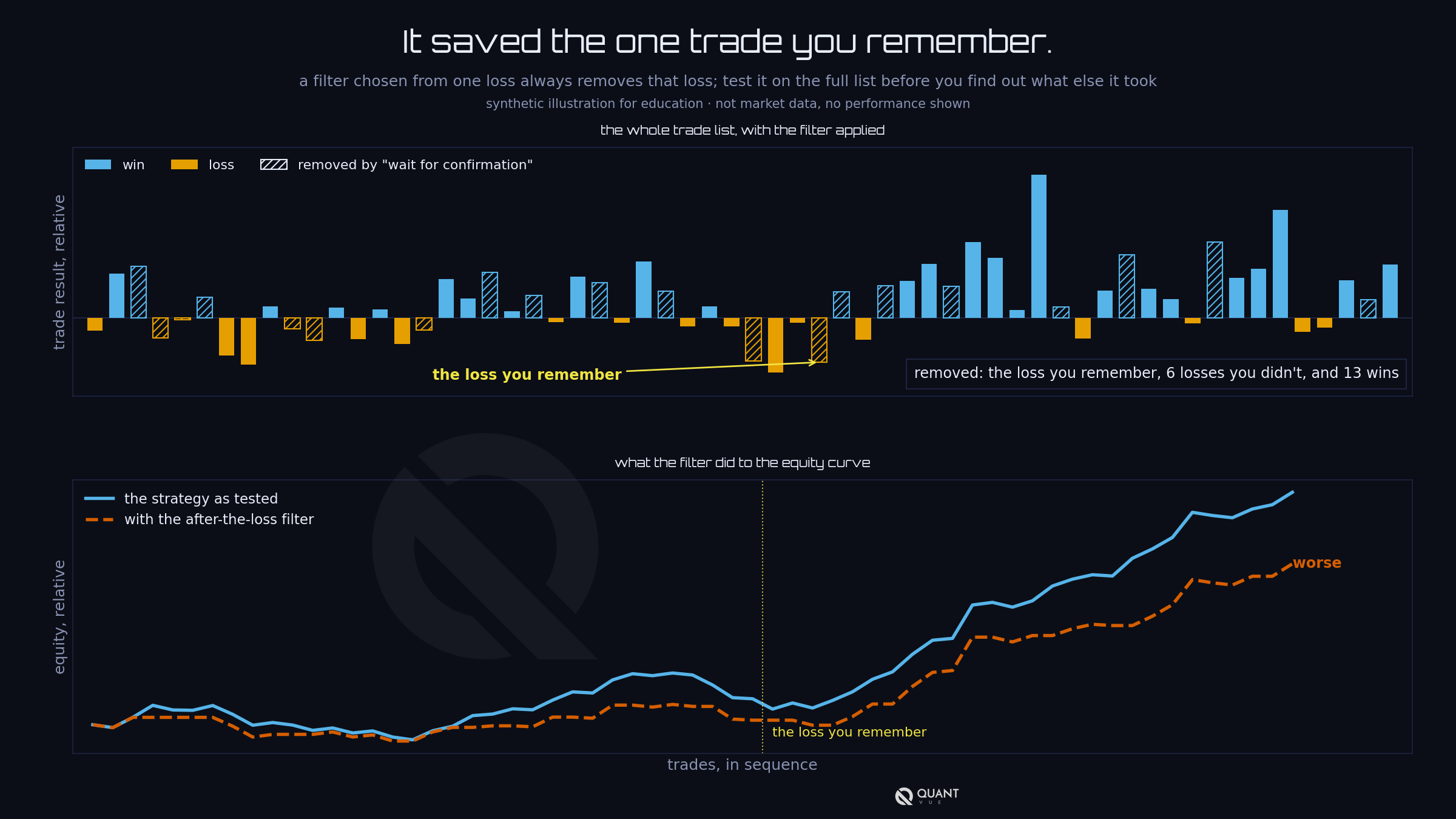
A filter built from one loss has a property you won't like. It always works on that loss. That's how it was found. You looked at the losing trade, scanned for anything that was different about it, found something, and named it. On one trade you will always find something. There are dozens of indicators with a hundred settings each, and something was always above or below something. That's the search being wide. Week two covered why the width matters. The more things you try, the more certain it is that one of them fits by chance, and this search ran in your head in about four seconds without you counting it as a trial. This is why we do things like a deflated Sharpe ratio in testing.
So test it the way you'd test anything. Write it down as a rule, exactly. "No entry while the 15 minute close is above its 20 period average." Apply it to every trade in the list, wins included. Count what it removes. Three things can happen. It removes the loser you remember, a handful of other losers, and few wins, and the Sharpe and profit factor improve. Rare, and worth keeping if it survives the trial count. Or it removes the loser and about the same share of wins as losses, and nothing changes except you trade less. Somewhat common. Or it removes the loser and more wins than losses, and the strategy gets worse. Most common, more common than people expect, because the condition that makes a trade look "unconfirmed" is often the same condition that gives the trade room to run.
That third case is the one to sit with. The confirmation you wanted had a cost you didn't see, because you only looked at the one trade where it would have helped. The trades it would have hurt weren't on your screen. Waiting for confirmation also means entering later, which means a worse price, a shorter distance to the target and a longer distance to the stop, and the two sweep lessons showed what that does. Filters that "wait" are usually a stop and target change in disguise, and you already know where those settings are supposed to come from.
Count the trial. If you test five "should have waited" filters over a month, that's five trials against the same sample, and the deflated Sharpe lesson tells you what the best of five looks like under pure noise. Log every one, including the ones that failed. If a filter survives the log and the full list, it goes onto the hypothesis card with a kill number, and it waits for the scheduled re-run from last Friday. It does not go into the live code on a Tuesday afternoon because a trade annoyed you.
This is why Friday's version matters more than Wednesday's. "It was obvious" is a feeling and it fades. "It should have waited for X" turns into a code change, and code changes stick. I've watched people take a strategy that survived the whole pass, add four filters in a month, each justified by a single trade, and end up with something that trades a third as often, has never been tested as a whole, and loses. Every step felt like an improvement. None of it was measured.
This happens very frequently as people adjust settings in order to improve their strategy on a weekly basis. This is just overfitting that you're working for. I change my settings, at most, twice a year. Yes, a YEAR.
Next one is what to do with a losing trade, in order, so the review has an output other than a new filter.
This lesson was originally sent to the Algo Creator School email list on October 2, 2026. New lessons go out by email regularly. Join the list at quantvue.io.
Educational content only, not financial advice. Futures trading involves substantial risk of loss and is not suitable for all investors. Individual results vary, and past performance, actual or simulated, does not guarantee future results.


After check out, you will receive a Welcome Email with your login details.
Use these details to Login to our dashboard, where you'll then submit your TradingView or NinjaTrader information.
Access is granted automatically if the form is filled out properly.
If you are having issues with access being granted, please submit a support ticket here.
No. Our core system is designed for those with baseline trading knowledge and live-trading experience. Do not sign up if you're a beginner trader. Intermediate to advanced experience is recommended.
No. There is no algorithm or indicator that can accurately predict with 100% certainty the financial markets.
QuantVue is not responsible for trading losses. Past results are never indicative of future performance. Use QuantVue and trade at your own risk.
Our tools are designed for futures. However, clients can tweak our toolkit to any chart or market.
Most clients use a paid TradingView plan, and the most popular among users is TradingView premium.
You can manage your account in the "My Account" tab or submit a support ticket here and we will process your cancellation immediately!
Our monthly & yearly Pro / Elite plans are backed by a 30-day money back guarantee. If you are not 100% satisfied within 30 days from the time of purchase, you may request a full refund.
Beyond the 30-day period, all sales are final.
The 30 day money back guarantee only applies to first time customers. If you have used our system or had a plan in the past, you are not eligble for a refund. This means if you have used the PRO plan in the past and sign up for ELITE at a later date, you will not be elgible for the refund guarantee and vice versa.
This refund policy does not apply to our ATS program.
See our full refund policy here.
There is a separate money back guarantee for the ATS Program. The ATS refund policy has certain conditions that must be met to receive a full refund.
See our full ATS refund policy here.
The Elite Plan on it's own does not automate into cash or prop firm accounts.
If you want to automate our tools into cash or prop accounts, you can do so via our alert connector QuantLynk here.
Keep in mind QuantLynk is detectable by prop firms, so we recommend using an automation-friendly prop firm.
To automate our tools into prop account undetected, we recommend our ATS Program here.
No. There is no free trial on the ATS program.